

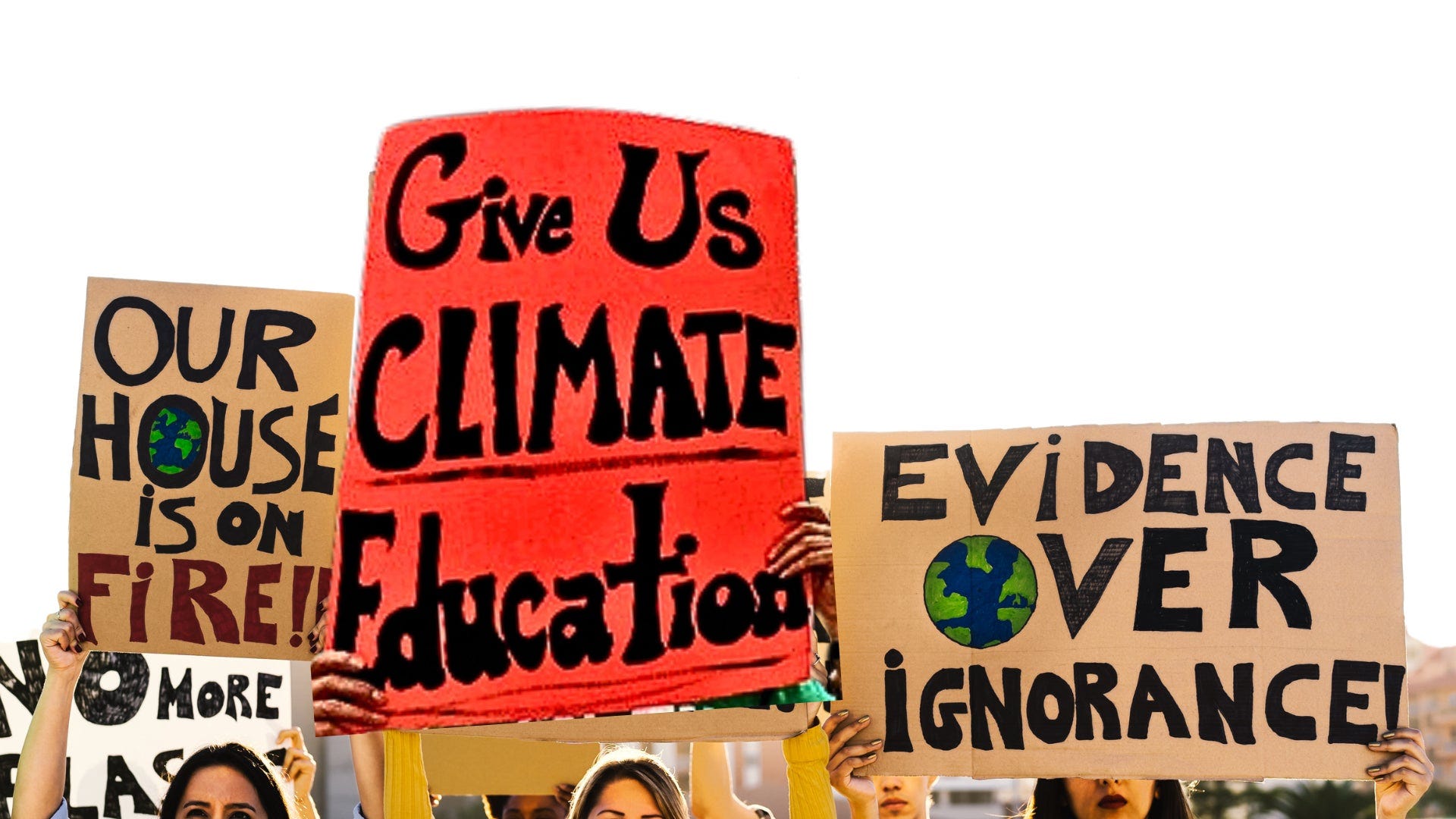
We’re a meaning-making species, we think in stories. We try to impose some narrative structure on, well, just about everything. We can’t make sense of a thing until we’ve worked out a story about it. It’s just how we’re made.
When we’re faced with the unsettling, strange realization that we, as a species, are changing the earth’s climate, we want it to make sense. Naturally, we tend to interpretations that gel with our broader view of the world. In our hyperpoliticized age, it’s not hard to guess what form this will take. Those who are generally skeptical of capitalism have plenty of raw material to put an anti-capitalist narrative frame on climate change. Those who are more worried about anti-capitalists than capitalism have plenty to work with, too.
The longer I work in climate, the harder I roll my eyes at politicized climate narratives. Catastrophism and denialism seem like variants of the same thing: shoehorning climate into political fights that don’t, in the end, have anything to do with climate. Climate catastrophism is overwhelmingly the domain of watermelon politics — green on the outside, red inside. Denialists deny what they deny from a place of contempt for catastrophists, not from any actual engagement with climate reality. Neither side actually has anything to say about climate as climate. It’s super boring.
The atmosphere doesn’t do narratives. It happily ignores all ideological agendas and follows the only law it knows: thermodynamics. Climate follows its own logic, a physical logic vastly more complex and more interesting than the paper-thin politicized narratives around it.
It’s that logic I want to engage with. The more I do, the more I understand why the politicized narratives ignore it: because it happily baffles both dominant political frames five times before breakfast.
Take the simple, foundational, rock-bottom question: how bad is it? With thousands of climate scientists now working on the problem all around the world and tens of thousands of papers published every single year, you’d think we’d have a basic handle on this question, but we don’t. The data we have pulls in both directions at the same time.
On the one hand, carbon dioxide emissions are just not rising as fast as climate alarmists thought they would even just a couple of decades ago. The demise of RCP8.5 earlier this year made clear the intellectual bankruptcy of some of the shrillest voices on the left. But if you think that’s a reason to relax and settle into the comforting bromides of right-wing climate discourse, the atmosphere has another think coming for you.
Even as emissions settle into a lowish concentration path, global average temperature rise appears to be accelerating. This is something climate models struggle to cope with. James Hansen, the dean of Earth System science, argues that the monster El Niño that’s brewing in the Pacific this year demonstrates those models are just wrong. So now you’re thinking that rescues the left-wing narrative, but that’s wrong too: the acceleration appears to be, perversely, caused by the success of environmental policies to clean up aerosol pollution, which has had the unintended consequence of withdrawing a cooling aerosol shield and letting the earth absorb more solar radiation.
There’s an overpowering urge to read climate news in narrative terms — to cheer the news that bolsters our narrative, boo the news that bolsters theirs. But the atmosphere isn’t going to referee the left-right climate debate: it’s immeasurably more complex than that. Appreciating that complexity demands that we step away from narratives as such and embrace the chaos that the firehose of science is pointing at us.
Much of the problem is that climate sensitivity —the basic question of how much temperatures rise in response to a change in greenhouse gas concentrations— is still a big fat unknown. Think about how messed up that is — the overwhelming reason we’re obsessed with emissions is that we figure lowering them will mean temperatures rise less quickly, but we still don’t really know what temperature rise corresponds with what level of emissions!!
The reason we don’t know is that the relationship is mediated by aerosols and clouds, but the science of aerosols and clouds is in a mess, with mongo error bars reflecting basic confusion about what causes what and how. There is a lot of very sophisticated research going into this problem right now, but those researchers will be the first to tell you they’re not close to solving the problem.
This is why calls to “follow the science” are so unhelpful. “The science” isn’t the tidy answer key in the back of the book that climate activists imagine it to be: it’s a cursed tangle of leads, half developed, pointing in contradictory directions. I have enormous respect for climate scientists, but I also talk to them enough to know they’re more aware than anyone of how far they are from figuring it all out.
The IPCC (the UN’s Intergovernmental Panel on Climate Change) with its mission to synthesize the wild mess of climate science outcomes into a message policy-makers can use, inevitably ends up confusing this issue. I understand the need for some sort of authoritative statement of what it is scientists mostly agree on, and what it is they don’t. But that is much more a function of the needs of policy-makers than of the scientific process. Forcing climate science to speak with one voice risks projecting an illusory consensus. A fully honest IPCC would produce guidance so vague and equivocal that policy-makers would find it worse than useless.
It’s not that climate scientists are incompetent: the ones I talk to are, as a rule, freakishly competent. It’s that the earth system is insanely complex: an overwhelming mess of physical, chemical and biological processes across land, sea and sky all feeding back on one another in non-obvious ways. Earth System scientists have made extraordinarily impressive progress untangling many of these relationships over the last few decades. I’m in awe of these people. Which is why I tend to take it seriously when I hear them say that there are huge gaping chasms around our understanding of the Earth System.
Go into almost any given sub-specialty and you find communities of researchers hyperaware of risks most of us are oblivious about. For my day job, I had to spend a good chunk of the spring looking at the way oceans produce nitrous oxide (N2O) — laughing gas to you and me, but no laughing matter in climate terms. Nitrous oxide is 273 times more powerful as a greenhouse gas than carbon dioxide, and oceans processes produce an awful lot of it.
Trouble is, the ocean nitrogen cycle is extremely complex, mediated by the still poorly-understood interactions of hundreds of thousands of different species of ocean microbes living hundreds of meters below the surface. As a result, the processes that generate nitrous oxide are in this strange place of being both a subject of intense academic study and an unholy mess of unanswered questions.
Models suggest that increasing ocean stratification, caused by rising sea surface temperatures, may lead oceans to generate quite a lot more N2O than they have in the past. The processes that do this tend to happen at middle depth, from 200 to 1,000 meters below the surface, which means you can’t get at them with a satellite, you have to go and sample the water, which is impossible to do at any sort of scale. So scientists are having to draw conclusions from pathetically sparse evidence sets, and while the techniques they use are sophisticated there’s only so much that statistical wizardry can do to overcome a skimpy evidentiary basis. All of which means that how much extra N2O, exactly, oceans may be producing is something we can only roughly guess at. And we know even less about when and where all the added N2O will ultimately be released into the atmosphere.
Some very cool science is being done to constrain the uncertainty in this area. “Constrain the uncertainty” is a lovely bit of jargon climate scientists use, meaning “to go from knowing fuck-all about a subject to knowing more-than-before (but-still-definitely-not-enough.”) Look, I’m in awe at the people who do this work. But they’re not under any delusion that they’re on top of the problem, because they’re not.
Of course, oceanic N2O may turn out to be a nothingburger, or it may turn out to be the thing that tips us into an even faster acceleration of mean global temperatures. I’m not trying to make you lose sleep about N2O specifically (although you definitely should.) N2O isn’t the point, ultimately: it’s just the one piece of the puzzle I happen to be sensitive to right now, because it’s the one I’ve been reading about.
There are plenty of other areas like this, niche-within-a-niche-within-a-niche bits of climate science that normies have never even heard of: brine rejection and Antarctic bottom water formation, how fast peat bogs in the Congo river basin will release carbon as they warm, how fast frozen subsea sediments around Siberia will thaw. A dozen others I don’t know about. And then there are probably other potential live climate feedback loops that nobody is fretting about just because we’ve not yet identified them.
You often hear people say that climate scientists are especially alarmed by the climate crisis, and that’s true. But people misinterpret that observation. They think it means scientists know something we don’t: that experts have a detailed understanding of the ways we’re fucked that the general public doesn’t have. There’s a comfort in that, a sense that somewhere out there wise people in white lab coats are on top of things, at least on a factual level.
But that’s backwards.
What scientists know that we don’t know is how much they don’t know. That’s why they’re scared.
In the public sphere, climate debates are going to remain trapped along the same old tired left-right axis as everything else. We’re meaning-making animals, we can’t do without our narrative frames. Those frames are orderly, they bring clear good guys and unambiguous bad guys into sharp focus.
The alternative is, in its own way, much scarier. Make the effort to actually look at climate science without overlaying an ideological frame on it, and you find a bewildering mass of often contradictory trends and probabilistic gambles. Uncertainty is absolutely pervasive. And boy is it deep.
That policy is going to get it wrong is pretty much guaranteed: deep uncertainty turns climate policy into Calvinball. You’re playing a game, but you don’t know what the rules are, you don’t know the score, you don’t know who the opponent is, and the rules, the score and the opponent all keep changing.
We’re a meaning-making species; we struggle to cope with situations where meaning is this evanescent. If we want to get it a little bit less wrong, though, we might as well start by doing the hardest damn thing: checking our instinct for narrative frame-making at the door. Putting it on hold, as best we can, long enough to try to actually absorb the exceptionally confusing facts of a problem that really is without precedents in human history.
Very, very few people are able to do this. It’s a very hard cognitive ask. I do my best to try to rise to this standard, and fail several times every day. Scientists struggle with it, policy-makers struggle with it. It’s hard. But if you want to not sound like an arse as you talk about climate, the single best thing you can do is to doubt every single climate narrative. And the more coherent and morally tidy it is, the more you should doubt it.
I have read this argument carefully. It is strongest when it points to real complexity in climate science, but it overreaches in what it concludes from that complexity.
Yes, climate science involves uncertainty... especially around cloud feedbacks, aerosols, and some biogeochemical cycles. But uncertainty in the details is not the same as uncertainty about the core mechanism. The basic physics: greenhouse gases trap heat and human activity is increasing them, is not in serious dispute within mainstream science.
Where the piece goes wrong is in treating “this is complex and imperfectly known” as if it implies “we don’t really know how bad it is.” That doesn’t follow.
Climate sensitivity is not unknown; it is constrained within a range that is narrow enough to meaningfully inform risk assessment and policy!!
It also draws a false symmetry between “catastrophism” and “denialism.” These are not mirror errors. One aligns with multiple independent lines of measurement and modelling; the other requires rejecting or downplaying them. Calling both “narratives” flattens an important epistemic asymmetry.
Finally, the idea that “follow the science” is meaningless because science is messy misses the point. Science is not a set of tidy answers: it is a structured way of narrowing uncertainty. In climate science, that narrowing is already strong enough to support action under risk, even if it is not perfectly precise.
Complexity does not cancel knowledge. It is exactly why probabilistic knowledge is useful at all!
I agree that the left-right narratives are unhelpful, but it seems like a fool's errand to expect people to check their need for a narrative at the door. As you say: This is almost impossibly hard even for those who try to do it in good faith. A better alternative would be to try to construct a compelling narrative around the things you talk about in your piece. But I understand that this, also, is very hard to do, because this narrative would probably be perceived as pretty boring, since it has to take into account so many unknowns. It seems humans not only need to construct narratives, but also for those narratives to push the right emotional buttons, so that people feel satisfied with them.