

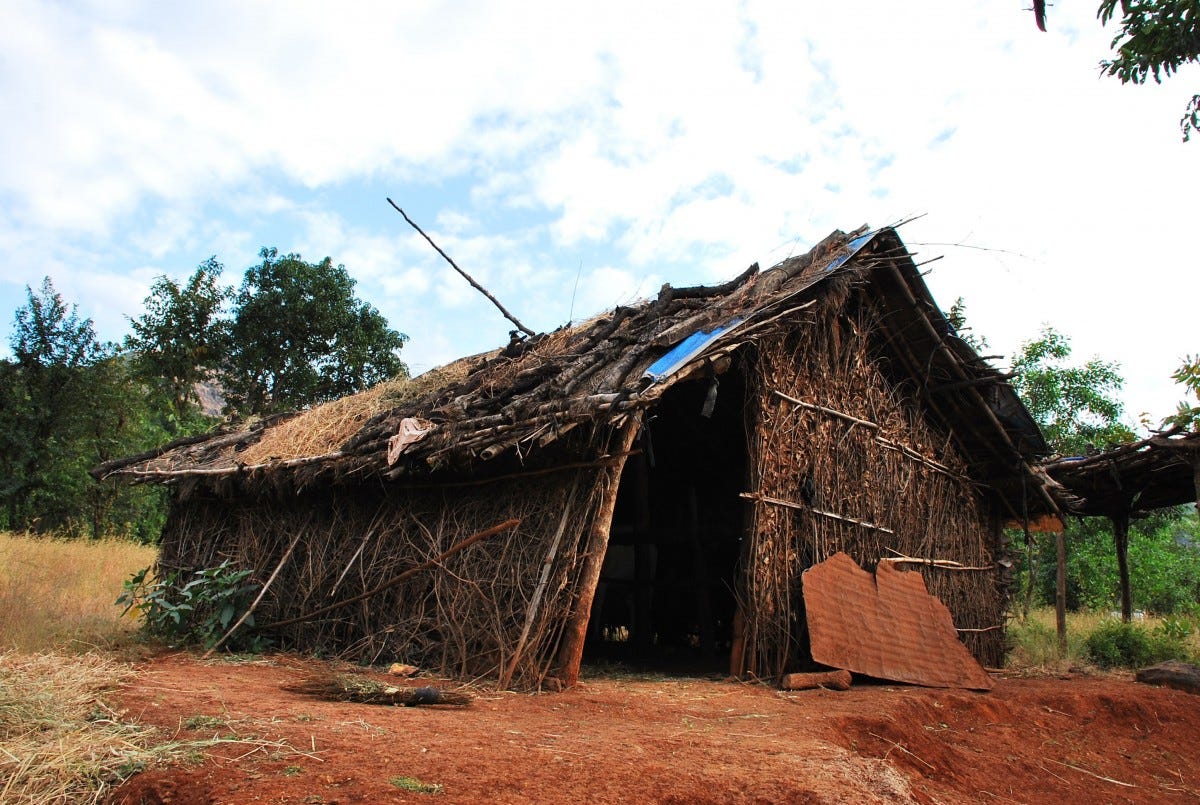
Say you grew up poor. Very poor. Your parents worked themselves to the bone farming on a small plot of land. There was never enough of anything. You hardly ever went more than a few kilometers from your village. Hunger was an ever-looming threat. Meat was rare and treasured. Most meals were just the same staple grain with a bit of salt, maybe some vegetables if you were lucky.
Your house looked something like this:
Your parents scrimped and saved to put you through school, and you were determined their sacrifice wasn’t going to be for nothing. You studied hard, and you did well. You finished high school, went on to technical training, learned things no one in your family had ever known, qualified for jobs much better than they could have had.
And you’ve done well. Well enough to help your aging parents now. Well enough to afford things they never could—meat when it’s not a holiday, trips to see them once or twice a year. You bought a window air conditioner on installments for those days when it gets really hot. Which come more and more often.
You have a good job now.
After years in a cramped apartment, you even qualified for a mortgage.
Your house looks something like this:
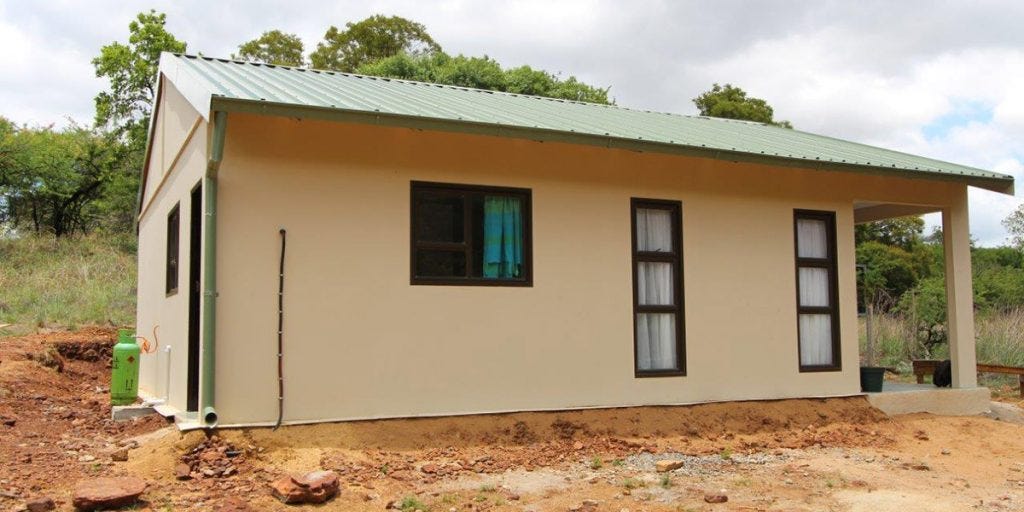
You’re nobody’s idea of rich. You’re one work accident away from losing it all. But you’re not poor in the way your parents were. You sleep on a foam mattress you got at a store, not on straw. Your kids don’t cry themselves to bed hungry. Things get tight at the end of the month, but you’re making it.
Maybe your job is in Lagos. Or Guayaquil, or Dhaka, or Chongqing. The farm where you grew up may have been in Nigeria, or Ecuador, or Bangladesh, or China. Probably China.
The thing is, you are not alone. There are billions of people like you, worldwide, who grew up very poor and now have a foothold in the global lower middle class.
Individually, each of you generates a fraction of the greenhouse gases the lifestyle of the average person in a rich country does. But there are many times more of you than there are people in rich countries. Which is why global emissions keep rising, even though emissions from rich countries keep falling.
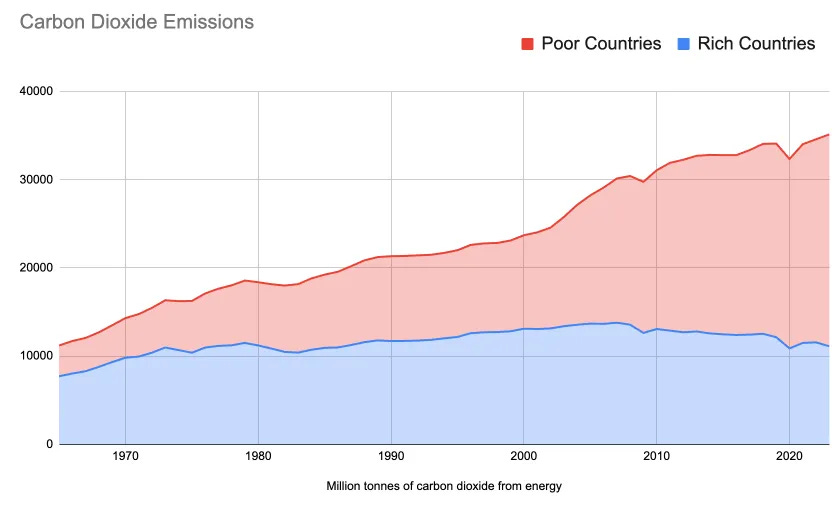
People in rich countries aren’t ready to face what your rise means.
We aren’t ready to accept that for millions of people like you, being less poor and consuming more stuff are pretty much synonyms. We don’t want to face the reality that when your consumption goes from near zero to not a lot, emissions rise.
This is about much more than where you get your power. Sure, solar panels are cheaper than ever. But you’re not just buying electricity. You’re buying a scooter to get to work instead of taking the bus. You’re buying a refrigerator so food doesn’t spoil. You’re replacing your corrugated metal roof with concrete. You’re taking the bus to visit your parents instead of walking. You shudder when you remember a childhood of eating just one staple grain meal after meal, and you treasure the variety of foods you can now afford: vegetables, processed foods and, yes, meat.
Rising into the global lower middle class means using more of everything—concrete, steel, transportation, food.
Every step up from poverty is built on physical stuff. And making physical stuff, moving physical stuff, keeping physical stuff cold—that’s where the emissions are. The electricity to power your lights is almost incidental.
The solar panels on your roof don’t change the fact that you bought a roof. They don’t change the emissions from the concrete plant, the steel mill, the scooter factory, the truck that delivered your refrigerator, the industrial farming that produces your chicken.
We aren’t ready to face the reality that you-being-less-poor and you-emitting-more-carbon are sides of the sane coin—not because you’re buying dirty electricity, but because you’re finally able to buy things at all.
Of everything the first-world climate commentariat is in denial about—and there’s a lot—this is the big one: that rising global emissions have little to do with what happens in the rich countries. They keep soothing themselves with misleading headlines about half of the world’s CO2 emissions coming from just 36 fossil fuel firms, as though those firms were emitting for the sake of emitting, instead of serving the demand from people like you.
Deep down, though, they must know that the story of rising global emissions are the story of you getting less poor.
We’re desperate for this not to be true. We want a villain we can properly hate. We want Climate Justice to mean sticking it to capitalist pigs, not reckoning with the fact that emissions are rising because billions of the world’s poorest people have lives incomparably better than their parents did.
We want the baddie to be someone easy to hate.
You’re not. So we don’t think about you at all.
Hi Quico. To say this "is why global emissions keep rising, even though emissions from rich countries keep falling" ignores the fraudulent accounting trick whereby emissions are lodged against country of production rather than against country of benefit. The main reason emissions from rich countries are supposedly falling is that these countries have arranged the world economy to enable them to offshore their emissions to poor countries through the transfer of manufacturing. The rich continue to benefit from high consumption but have palmed off much of their responsibility for the warming effects of their affluence to the poor.