

Two mechanisms determine the planet’s temperature trajectory: the greenhouse effect and planetary albedo. We have a pretty good handle on the first, but the second remains a muddle, and a wildcard.
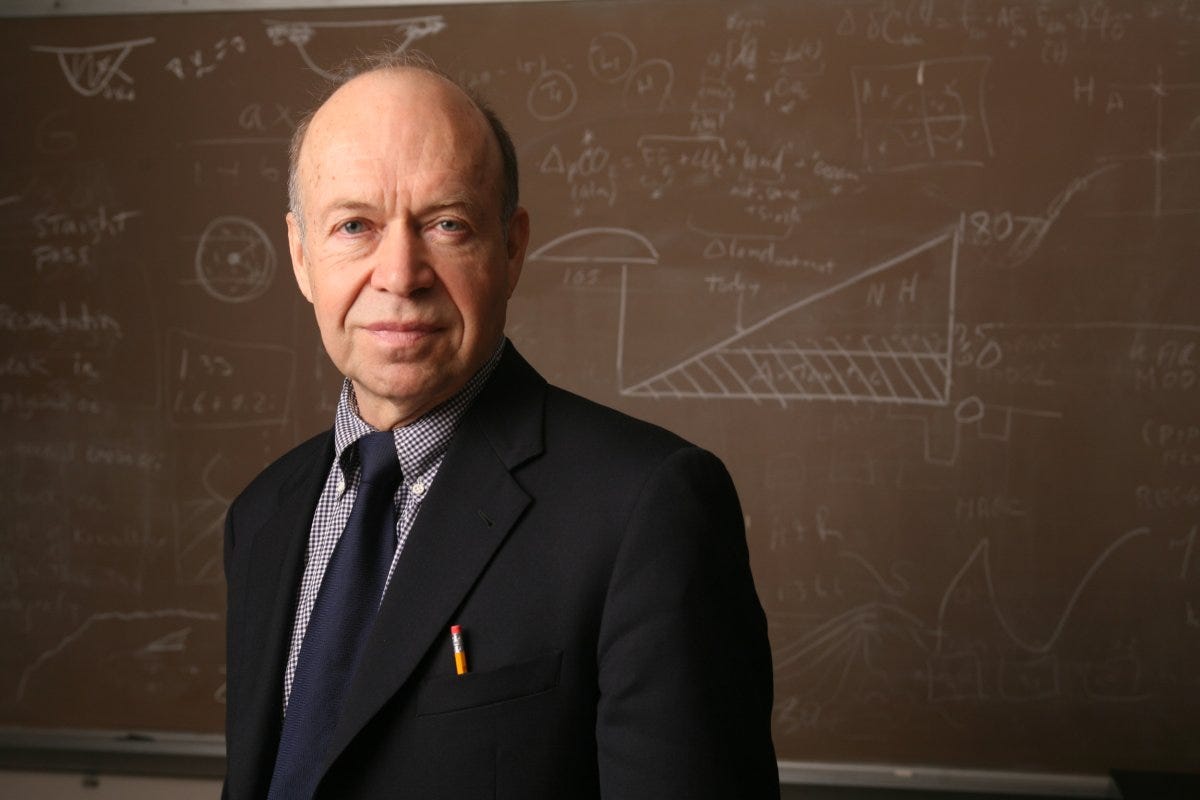
One very senior scientist in particular —Columbia University’s James E. Hansen— keeps warning us that mainstream science is getting albedo badly wrong. If he’s right, we’re in for a much bumpier climate ride than we realize.
Changes in albedo —the proportion of the sun’s energy that gets reflected back out into space, rather than absorbed by the earth— turn out to be tricky to model. The way clouds interact with aerosols, in particular, continues to stump scientists: it’s the biggest source of uncertainty in the IPCC’s estimates.
Hansen argues that some types of pollution make clouds much brighter, and albedo much stronger, with the unfortunate and paradoxical effect that cleaning it up accelerates global warming. If he’s right, we’re facing 4 or 5 degrees of warming, not 2 or 3. And that’s a much, much more unstable atmosphere.
It would be nice to be able to dismiss Hansen as some sort of crank, but he certainly isn’t that. Hansen is one of the world’s most highly regarded climate scientists. He’s the guy whose 1988 congressional testimony first brought concentrated attention to global warming as an issue of political significance.
Hansen’s views on climate sensitivity and cloud-aerosol interactions certainly are out of consensus, but that doesn’t mean they’re wrong. He expresses them with verve, in language accessible to everyone. You should read his latest note, it’s sobering.
We’re so used to seeing the IPCC’s views questioned by skeptics that we’re weirdly ill-at-ease considering the alternative possibility: that the scientific mainstream is complacent about the risks we face. This leaves guys like Hansen in a peculiar predicament: criticizing the IPCC not for being alarmist, but for failing to sound the alarm loud enough.
Hansen argues that air pollution —mostly sulfur compounds from industry and especially from ocean-going shipping vessels— increased albedo by making clouds brighter. That boost to albedo masked some of the global warming we ought to have experienced due to rising greenhouse gas emissions. Rapid improvements in air quality over the last 20 years have withdrawn that veil, leading to accelerating warming.
It’s easy to see why this message has trouble breaking through to the public. Hansen is saying that air pollution, which is a bad thing, has some beneficial impacts, while policies against air pollution, which are a good thing, have some detrimental impacts.
We’ve been on the receiving end of decades of activism that paint pollution as everywhere and always bad, and cleaning up pollution as uncomplicatedly good. We’re now deeply committed to climate as a simple morality tale, where mother earth rewards virtuous behaviour with a clement climate, and punishes our transgressions with bad climate. That’s a comforting tale of an ethically ordered universe. Hansen’s warning upends all these neat correspondences. Of course that makes us squirm.
If James Hansen is right, we’re in big big trouble. Way bigger trouble than we realized. If James Hansen is right, the most serious climate impacts could start piling up within just a decade or two, not deep into the 22nd century as standard climate models suggest. If James Hansen is right, we need to get over our shit and understand we’ve been unwittingly managing solar radiation for half a century, and have only recently stopped doing it, leading to a kind of undiagnosed termination shock from the cessation of an unintended spell of geoengineering. If James Hansen is right, the case for dramatic interventions to curb the worst impacts of climate change is much stronger than we’d realized.
I, for one, am not qualified to opine on whether Hansen is right or wrong. He’s a serious enough, senior enough researcher that we should certainly act as though there’s a non-zero probability that he’s right. How far from zero? I don’t know. But I think p(hansen) should serve as a kind of climate counterpart to the popular p(doom) of the AI debate.
My p(hansen) right now is at about 20%: worse odds than you get playing Russian Roulette. If there really is a one-in-five chance we’re heading to a five degree hotter world, we should be doing much more than we are to address the eventuality. Because a five degree hotter world really would be a genuine calamity: it’s not just the rapidly rising sea levels and the prolonged and deadly heat waves, it’s that every climate tipping point in the book begins to look likely at five degrees, from AMOC collapse to a permafrost methane burst to rapid agroecological collapse across the tropical world. A nightmare.
A one-in-five chance that that’s the world we’re heading towards ought to chill you to the bone.
Unless your p(hansen) is at zero, you have to conclude our climate budgets are being disastrously misallocated. While we pour hundreds of billions of dollars into subsidies for solar cells and heat pumps, the basic science of Aerosol-Cloud Interactions continues to get nickel and dimed.
The International Maritime Organization continues to push to decarbonize bunker fuels, even though cloud condensation nuclei from shipping may be the thing that had been shielding us from disaster. And researchers looking into ways of restoring some of the albedo-enhancing effects of pollution in less destructive forms continue to be marginalized by a climate movement laser-focused on interventions that stopped making sense decades ago.
Unfortunately, no: I don’t know if James Hansen is right. But he might be right. And God help us if he is.
Historical contribution of aerosols to radiative forcing remains the largest source of uncertainty in IPCC syntheses. See: https://www.ipcc.ch/report/ar6/wg1/figures/technical-summary/figure-ts-15/
In particular the kind of cloud-aerosol interactions Jim is concerned about. Given the far shorter mean lifetimes of most aerosols, compared to anthropogenic CO2, changes in their forcing could act faster than changes to CO2 emissions, as Quico notes.
I know and respect Jim Hansen. Most people in the climate science community have a lot of respect for him. You can agree or disagree but I would never dismiss Jim's concerns out of hand.
A 5-degree warmer would be a different planet from the one we inhabit now. Consider the transition from the Last Glacial Maximum included a warming of ~5 degrees (estimates vary). That was over a far longer time scale than the current anthropogenic perturbation. Uncertainty "bars" (however derived) have two ends. Prudent risk management should consider the implications of both ends.
The precautionary principle means restoring planetary albedo should be the top climate priority, walking back from the heat precipice of tipping points.