

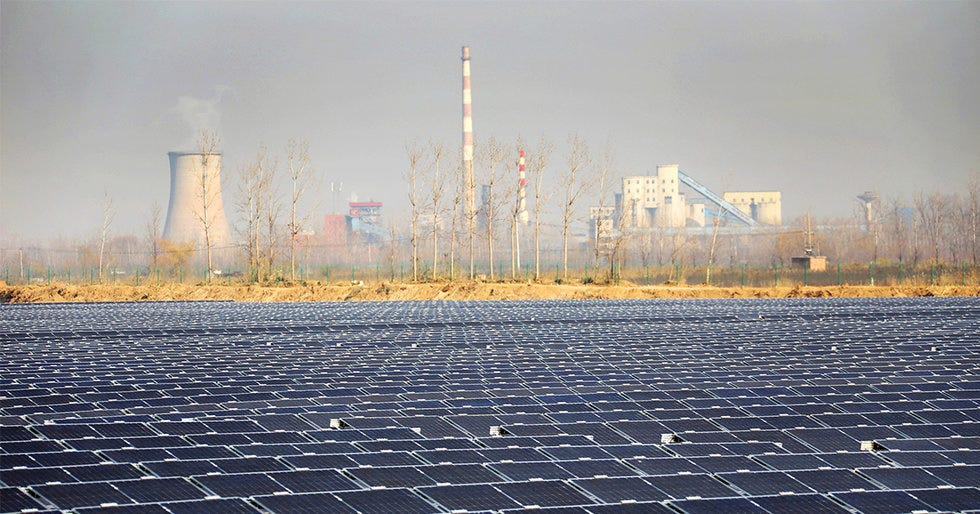
Climateworld is conflicted about China. On the one hand, the People’s Republic gets plaudits for its amazing achievement in renewables, especially solar. The wild growth in solar generation capacity in the last decade is a story of crushingly effective Chinese industrial policy: proof that when a big power really puts its mind to it, it can make stunning progress on green energy quickly.
The rub is that China’s solar renaissance happened at the same time as its greenhouse gas emissions exploded. Why? Because China went on a coal binge at the same time it spearheaded the renewables revolution.
The scale of China’s coal industry is staggering: around 1,000 coal power stations operating more than 3,200 generation units, with a nameplate capacity around 1.2 terawatts. China’s installed capacity from coal alone — 1.15 terawatts — is about the same size as the entire U.S. electrical system.
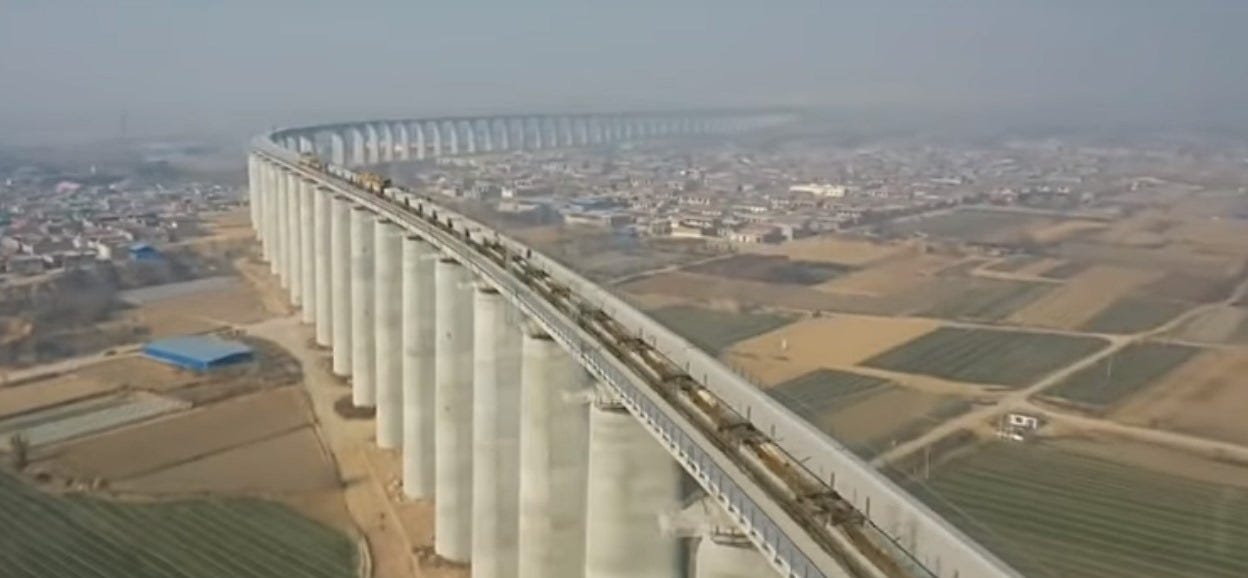
More than half of the coal consumed worldwide is now consumed in China, and they’re not slowing down. China is still building coal generation capacity at near-record rates. In 2024 alone, it started contruction on 94.5 gigawatts of coal plants, more than the total generation capacity of Vietnam or Poland. 2.5 million Chinese workers are directly employed in the coal industry, whole provinces depend on coal.
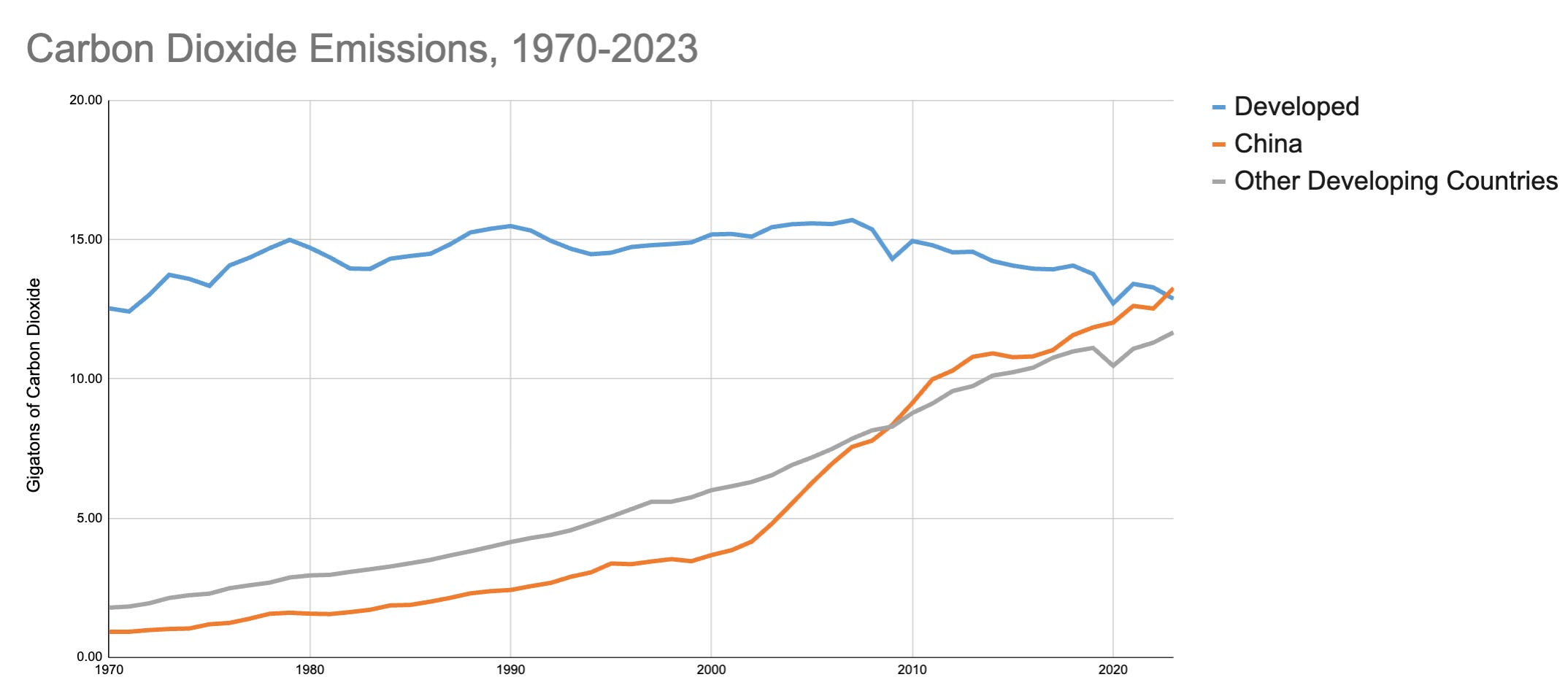
All of which helps explain why the undisputed world leader in renewable energy now emits more carbon dioxide than all the developed countries in the world put together. For that matter, China now emits more CO₂ than all the rest of the developing world combined, too:
China’s simultaneous embrace of the cleanest and dirtiest energy technologies looks like a contradiction, but only if you’re thinking ideologically. If you’re thinking like a grid planner, there is no contradiction. Because renewables work great…some of the time. If you’re in the business of planning a grid, the obvious question is what you’re going to do the rest of the time.
When Chinese grid planners looked at their geopolitical reality, it didn’t take them long to come to an answer. China doesn’t have much oil, but it has an almost limitless supply of coal. For a country that prizes energy independence for geopolitical reasons, depending on imported fuel sources was a non-starter. Building out solar-and-wind required building out coal at the same time.
The better question is why it feels to us as though China’s parallel solar-and-coal build out is contradictory.
The answer, I think, is that Western campaigners have spent decades constructing a narrative of renewables as a substitute for fossil fuels. They’ve been very successful. We’re so used to hearing solar and wind described as replacements for coal and oil that we don’t entertain the possibility the framing is nonsense.
In China, though, none of this is theory. They know solar and wind won’t work in the absence of coal and oil.
In the discourse, batteries are meant to step in to quell the cognitive dissonance this all provokes. It is true that battery prices have come down quickly over the last few decades. It’s now just about imaginable to install enough to cover your evening peak demand with your extra afternoon-solar generation. But these four-hour storage options are expensive, and costs soon become prohibitive if you need to cover eight or 12-hours worth of power.
Renewables boosters tend to talk as though continued falls in battery-storage prices are an immutable law of nature, a Moore’s Law-type regularity you can bank on. In the real world, lithium-ion batteries appear to be closing in on their fundamental physical limits: continued price reductions are in no way assured.
Which suggests China really is the future: the more we invest in weather-dependent renewables, the more we end up depending on fossil fuels. As renewable-penetration begins to climb beyond critical thresholds —the number depends a lot on your grid design and your geography, but it’s somewhere between 15% and 50%— the marginal cost of renewable generation becomes prohibitive.
The implication feels weird to us because our discourse is so divorced from the realities of running a real grid. To Chinese Communist Party planners, there’s no real mystery: the more wind and solar you install, the more coal you need to burn to keep the lights on when the sun doesn’t shine and the wind doesn’t blow.
There is, of course, an alternative to this paradigm: a zero-carbon energy source that works day and night, takes up almost no land, and at scale can be as cheap as coal.
If you want a carbon-free grid, its backbone will be nuclear.
The idea that energy is neatly divided into "clean" and "dirty" is overly simplistic, but the way China’s energy strategy is often framed also misses key nuances. While China is indeed building a lot of coal *capacity*, that doesn’t automatically mean it’s burning significantly more coal. The distinction matters.
When you build out renewables, you need backup power to handle fluctuations in supply. Flexibility can come from electrochemical batteries, pumped hydro, or backup generators. China has chosen to use coal plants as flexible generators—a costly and inefficient approach—but one that aligns with its obsession with energy security. Unlike many Western countries, China avoids relying on gas or diesel for backup, even though those options would be more economical. Their priority is avoiding dependence on imported fuels, even at the expense of efficiency.
It’s entirely possible to achieve 80–90% renewables penetration at a relatively low cost with current technology, provided you have the right storage and grid management. But this discussion often overlooks nuclear, which faces a similar challenge: it’s an inflexible power source. Nuclear plants can’t easily ramp up or down to match demand fluctuations, which is why Europe historically paired nuclear expansion with pumped hydro projects. Fortunately, modern lithium batteries can now help compensate for nuclear’s inflexibility, just as they do for renewables.
Finally, comparing graphs of renewables and coal build-out without context is misleading. In the West, renewables expanded during periods of stagnant or declining energy demand, so every unit of renewable energy directly displaced fossil fuels. China’s situation is different—its energy demand is still growing rapidly. Without renewables, coal demand would be even higher. The fact that coal’s *share* of China’s electricity mix is decreasing—despite absolute coal capacity increasing—shows that renewables are meeting new demand that would otherwise have been filled by coal.
So yes, nuclear needs storage or flexible backup just like renewables. China’s reliance on coal for flexibility is a deliberate (if inefficient) choice driven by energy security concerns. But the broader lesson is that any low-carbon energy system—whether based on renewables, nuclear, or even coal—requires storage and flexibility to function effectively. The real question isn’t just about building capacity, but about how to integrate it intelligently.
You make a strong claim that Chinese grid planners know coal (an inflexible power source) MUST complement renewables, and this is abundantly obvious to them. Can you provide a report from a Chinese planning committee or a quote from a bureaucrat to support this?
Did you make up this anecdote?