

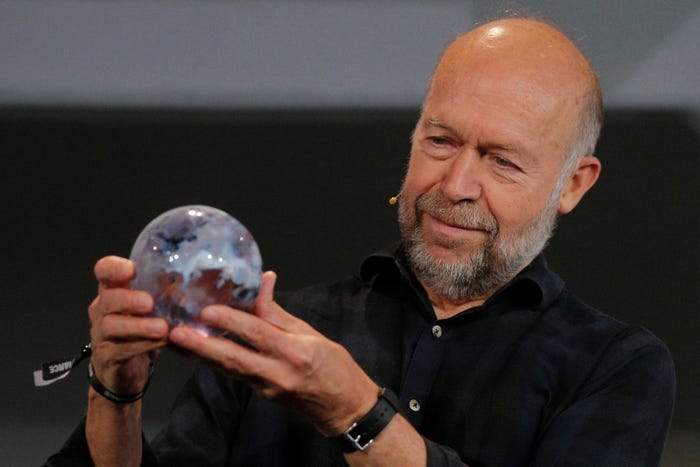
For an 84 year old, James Hansen has a remarkable knack for stirring the pot. The man who first brought Climate Change into the public imagination remains one of the planet’s most closely watched climate scientists. But rather than settling comfortably into the climate science mainstream he once embodied, he’s become an increasingly ardent critic: slamming mainstream science for dramatically underestimating the amount of warming Earth is likely to face.
His latest hobby horse? The El Niño cycle is all out of whack.
But first, here’s the lay of the land for this controversy: the Intergovernmental Panel on Climate Change — the IPCC, the body that synthesizes the global scientific consensus on climate — estimates that if you doubled the amount of CO₂ in the atmosphere, the planet would eventually warm by about 3°C. Jim Hansen says it’s at least 4°C.
What the earth’s actual “climate sensitivity” is matters enormously. If Hansen is right and the IPCC is wrong, we’re in for a much rougher climate ride than we’ve realized.
The debate is wonky, and can come across as irresolvable: one set of nerds has one set of numbers, another set has another set, the math behind each is baffling and you have no way to tell who’s right.
Except Hansen thinks he can prove he’s right not someday in the far future, but before the next summer Olympics. That’s why he’s put a specific, falsifiable prediction on the table: global temperatures, measured as a 12-month running mean, will bottom out at around 1.4°C above pre-industrial levels in early 2026 — during the current La Niña — and then rise to around 1.7°C by early 2027, as the next El Niño kicks in.
If that happens, he argues, it’s game over for the low-sensitivity models.
What’s an El Niño Got to Do With It?
Think of the tropical Pacific Ocean as a giant bathtub that sloshes back and forth. Normally, trade winds push warm surface water westward, toward Indonesia and Australia. Cold water wells up near South America to replace it. That’s La Niña — the cool phase.
But sometimes the winds weaken or reverse. Warm water sloshes back east. The cold upwelling stops. Heat that was stored in the ocean escapes into the atmosphere, and global temperatures spike. That’s El Niño.
El Niños don’t cause global warming — they temporarily reveal heat the ocean has been storing. It’s like opening the oven door: the kitchen gets hotter, but the heat was already there. What makes them useful for Hansen’s argument is that they act as a natural stress test. An El Niño forces the climate system to show its hand.
The thing is: we just had one. The 2023-24 El Niño ended barely two years ago. Normally, the ocean needs longer than that to recharge — to rebuild the pool of warm water in the western Pacific that fuels the next event. In the last 75 years, no strong El Niño has followed another one this quickly.
So if a substantial El Niño develops in 2026 anyway, that itself is a signal. It would suggest the ocean is accumulating heat faster than it used to.
The Aerosol Dimension
The standard story of global warming is straightforward: we emit greenhouse gases, they trap heat, the planet warms. But there’s a hidden variable that typically gets snipped out of the picture: aerosols.
When we burn fossil fuels, we don’t just produce CO₂. We also produce sulfur dioxide and soot and other particulate matter that drifts into the atmosphere and ends up cooling the planet by reflecting solar radiation back out to space. Aerosols also seed cloud formation, and clouds reflect sunlight too. For decades, this aerosol cooling has been partially masking the full warming effect of greenhouse gases: like we’ve been running the heating and the air conditioning at the same time.
Starting around 2015, aerosol emissions began to drop — fast. Mostly, this was good news: China launched an aggressive clean-air campaign that dramatically cut sulfur dioxide emissions and prevented many, many Chinese people from dying horrible deaths from respiratory illnesses caused by air pollution. But it also cut down on the reflective aerosol particles that were offsetting some of our global warming.
Then, in 2020, new international regulations forced the shipping industry to switch to cleaner fuels, cutting sulfate emissions from cargo ships. That, again, turned down the air conditioning.
Hansen argues that this reduction in aerosol cooling is a major reason global temperatures have surged in recent years. It’s not just that greenhouse gas forcing has increased — which it has, by about 20% between 2010 and 2015. It’s that the aerosol mask has been ripped away. And if you put those two things together — higher sensitivity and reduced aerosol cooling — you get a planet warming much faster than the standard models predict.
Why the IPCC Gets It Wrong (If Hansen Is Right)
Hansen charges the IPCC with relying heavily on Global Climate Models — massive computer simulations that try to capture the physics of the atmosphere and oceans. These models handle some things well. They simulate water vapor feedback accurately, for instance. But Hansen argues they systematically underestimate cloud feedback — the way warming changes cloud cover in ways that amplify further warming. Clouds are fiendishly hard to model. They form and dissipate at scales smaller than most climate models can resolve. They’re the source of most of the fat error bars around the IPCC’s climate sensitivity estimates. They know they don’t know how to model them. Hansen thinks if they modeled them right, they’d realize we’re in way deeper shit than we realize we are.
IPCC models produce a climate sensitivity centered around 3°C — not because the physics demands it, but because the models can’t fully capture the feedback loops that would push it higher. Hansen points to four independent lines of evidence — paleoclimate data, observed warming patterns, ocean heat content, and direct measurement of Earth’s energy imbalance — that all converge on a sensitivity of at least 4°C.
The IPCC, he says, has been giving too much weight to models and not enough to observations.
So what happens now?
As of early 2026, the tropical Pacific is in a La Niña phase — the cool side of the cycle. But climate models and recent wind patterns suggest a transition to El Niño later this year. Westerly wind anomalies over the past month have been weakening the trade winds, allowing warm water to slosh back eastward. If these wind patterns persist through the northern hemisphere spring, a substantial El Niño could develop by summer.
Hansen is characteristically blunt about what this means. If global temperatures bottom out around 1.4°C during this La Niña — a level higher than any El Niño peak in the decade before 2023 — that alone would be powerful evidence that global warming is accelerating sharply. He bolsters the case by noting that the 12-month running mean of tropical Pacific upper ocean heat has a correlation of more than 50% with running-mean global temperature, “leading global temperature by 9 months,” while the Nino3.4 index — the standard El Niño measure — has “slightly higher correlation, but a lead time of only 4 months.” (If your eyes just glazed over, welcome to the James Hansen reading experience.)
Hansen is saying the ocean data he’s tracking is already flashing warm. If temperatures then rise to 1.7°C during the next El Niño, it would be very difficult to explain without invoking high climate sensitivity and reduced aerosol cooling — because, as Hansen puts it, climate feedbacks “do not come into play in direct response to a climate forcing, but rather in response to the (delayed) temperature change caused by the forcing,” and it’s precisely those feedbacks that “distinguish high sensitivity from low sensitivity.” Translation: give it a year or two after an El Niño, and the temperature response will diverge sharply depending on whose models are right. It’s easy to get lost in the details, the point is that the La Niña trough we’re in now is already inconsistent with IPCC models, and the El Niño peak we’re about to experience will be even more so.
“This is the sort of bet,” Hansen writes, “that one prefers to lose.”
Please, God, let Hansen be wrong
Let’s be clear about what it means if Hansen is right.
It means 2°C of warming — the threshold the Paris Agreement was designed to prevent — arrives in the 2030s, not mid-century. It means the window for meaningful climate action is considerably narrower than most policymakers assume. It means the comfortable framing of “we have until 2050” — which already felt optimistic — is just flat-out wrong.
Jim Hansen has been sounding the climate alarm since his famous 1988 congressional testimony, and he’s had a better forecasting record than the mainstream consensus for nearly four decades. His contempt for colleagues who disagree with him can be grating — he accuses the climate establishment of responding to his papers in “juvenile, unscientific fashion,” which is not exactly how you build coalitions. But he has a track record that demands attention, even when — especially when — his conclusions are uncomfortable.
I hate it that his ideas are trapped inside prose that only specialists can parse. If you’ve ever tried to read one of his Substack posts, you know the experience: you start with genuine interest, hit a wall of acronyms and chart descriptions around paragraph four, and emerge twenty minutes later unsure what you just read but vaguely anxious.
What he’s saying, stripped of the jargon, is that we have less time than we think, the evidence is about to become undeniable, and the climate science establishment needs to get its shit together and face this. Whether you find that credible or alarmist, the next eighteen months of temperature data will bring a clarity this discussion is sorely in need of.
Because the thermometer doesn’t care about anyone’s writing style.
What is also seldom talked about is that forests and oceans also produce not only Sulphur related cloud condensation nuclei but so much more and all are under stress. One could only assume the negative thermal mass of water and ice is currently helping moderate more extremes.
Quico--The critical question isn't "how bad will it get?"
The key is: WHAT are we going to do about global warming? WHO is going to do it? WHO will pay for it?
We already know that something needs to be done. We don't really need to convince an undefined "them" to do an undefined "something". We know how nature has done it (localized ocean fertilization), and we know that 8000 large corporations have net-zero commitments with budgets already for removing carbon. Now we need to get off the mark and act.
I love Jim Hansen--his talks 25 years ago got me started on this path. I diverged from him 12 years go, focusing on the What to do and Who to do it. He hasn't liked that--What and Whom and When are not scientific questions--they're leadership and moral questions.
Writers need to be discussing what to do, and who to do it.
Hansen makes clear, over the decades, that governments and scientists are not empowered to discuss what to do or whom to do it.
-Margaret Mead said,"Never doubt that a small group of thoughtful, committed citizens can change the world; indeed, it's the only thing that ever has."
Our climate restoration community is taking on the goal of restoring CO2 and the climate using Nature's safe and efficient methods. Yes it appears that the scientific community is saying to slow down and not act yet, but that's what they're paid to do, as advisors. Advisors must always be conservative.
Quico-Good work. Keep writing about this.