

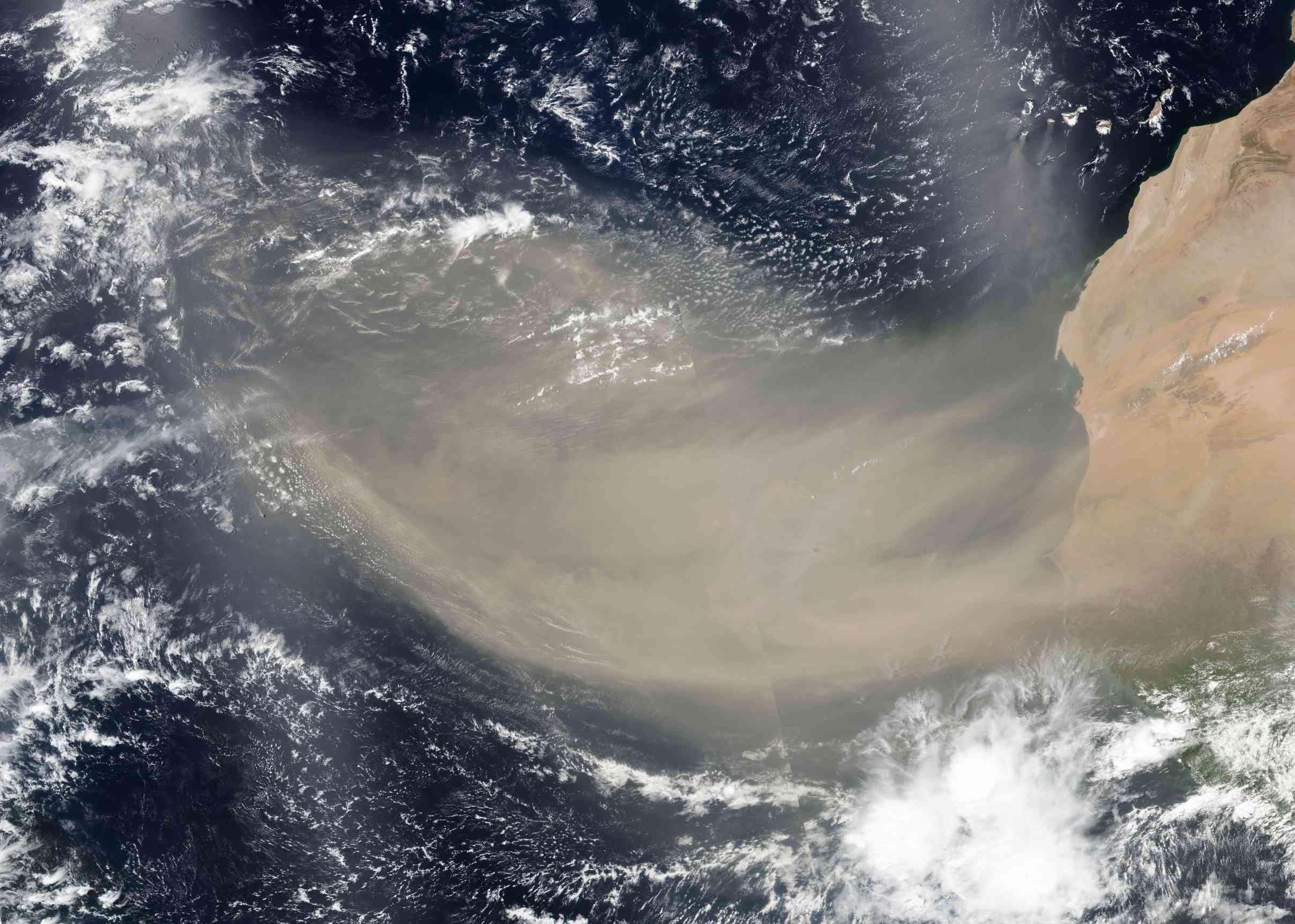
Adding nutrients to the ocean so tiny ocean plants remove carbon dioxide from the atmosphere is an idea that people aren’t used to. Unfamiliar ideas make us uncomfortable. That gut level “I’m not so sure about this” is natural enough. It comes out as an inchoate sense that such a thing must be risky, that we’ve never done it before and so couldn’t possibly know what the consequences would be.
It’s not true, though. We have quite a precise understanding of what happens when you add nutrient-rich minerals to nutrient-poor waters. Dozens of natural experiments have settled the question. Because nature puts minerals into the ocean all the time, all around the world, through many different mechanisms. And it’s been doing so for millions of years.
Volcanoes do it. Wildfires do it. Even educated whales do it. Dust storms and icebergs do it too. And because satellites have been measuring the ocean’s color with minute accuracy for over twenty years, and research ships have been chasing these events with sensors and sample bottles, we have a large and growing record to show what happens when nutrient-starved water suddenly gets fed. It’s one of the best-documented cause-and-effect relationships in ocean science.
Remember, most of the open ocean is a desert. The top layer of water gets plenty of sunlight, but as you get farther from land the tiny drifting plants that form the base of the marine food web — phytoplankton — run short of one or two key ingredients, usually iron, sometimes nitrogen or phosphorus. Give them what they’re missing and they multiply, sucking carbon out of the air in the process. Take the nutrient source away, and within weeks the effect fades. The pattern has been observed over and over, in different waters, driven by different processes, sort of everywhere.
Tonga on my mind
One case of particular interest to me comes from the subtropical South Pacific. It had long been hypothesized, but never proven, that shallow undersea vents near Tonga might be leaking iron-rich fluid close enough to the surface to reach sunlit water and feed nitrogen-fixing bacteria.
Then, in 2019, a research cruise went and found it.
A single string of undersea vents feeds a patch of ocean the size of Germany with enough iron to fuel a bloom of nitrogen-fixing bacteria that grew two to eight times faster than those in the surrounding water, and pulled two to three times more carbon down into the deep ocean. That work was published in Science in 2023. Follow-up cruises mapped exactly how sharply the iron levels spiked near the vents and faded away with distance, tracked the plankton response cell by cell, and even built a nitrogen budget showing that in some seasons, nearly all of the region’s biological productivity runs on vent iron.
The Tonga-Kermadec range isn’t unique, either. Similar iron-fed blooms have now been traced to volcanic ridges south of Africa, near Antarctica, and scattered across the Pacific seafloor — some fed by iron plumes that drift over a thousand kilometers before they’re used up. One recent study even linked the strength of a Southern Ocean bloom, year by year, to how many small earthquakes had recently shaken the nearby volcanic ridge: more quakes appear to be related to more iron release, which leads to more phytoplankton growth.
All we are is dust in the wind
But in fact, undersea vents are a little niche; the best-known natural fertilizer delivery system is dust in the wind. Every year, wind lifts millions of tons of fine soil off the Sahara and carry it out over the Atlantic; the same thing happens with dust off the Gobi desert blowing over the North Pacific, dust off Patagonia settling onto the Southern Ocean, and dust off drought-stricken southern Africa reaching all the way to Madagascar. Scientists have been measuring these sorts of events for decades: wherever iron-rich dust lands on iron-starved water, phytoplankton growth follows, often within one to two weeks.
Maybe the clearest evidence comes from robotic ocean floats that happened to be sitting in the North Pacific when a Gobi dust cloud rolled over them in 2001. The floats measured the living carbon in the water nearly doubling within two weeks. A dust storm over the Arabian Sea in 2012 was followed by a nearly fivefold jump in chlorophyll. A 2024 study using over a decade of ocean-robot data concluded that nutrients from dust currently sustain roughly a third of all the plant growth happening across the entire Southern Ocean each year — and that during the last ice age, when the world was far dustier, that figure was closer to two-thirds. Deserts, in other words, have been fertilizing oceans on a hemispheric scale for as long as there have been deserts.
Ashes to ashes
Volcanic ash shows these events in sharp detail, because the nutrient additions are sudden, violent, and easy to date them precisely. In August 2008, an Aleutian volcano called Kasatochi erupted and dropped ash across the Gulf of Alaska. Within days, satellites picked up one of the largest phytoplankton blooms ever recorded in that part of the Pacific. When Iceland’s Eyjafjallajökull volcano — the unpronounceable one that grounded European air traffic back in 2010 — dusted the North Atlantic with ash, research ships sailing under the plume measured a spike in dissolved iron and ran shipboard experiments showing the ash was actively feeding the local plankton. The same thing happened after Hawaii’s Kīlauea eruption in 2018, when ash carried more than a thousand miles out to sea triggered what may be the largest bloom ever observed in that stretch of the Pacific, an area of ocean roughly five times the size of Taiwan. It happened again around a small Japanese volcanic island in 2020, and around a Mariana Islands volcano in 2003, in one of the most nutrient-poor patches of ocean on the planet.
It’s not just that researchers have watched these processes from space. They’ve collected ash samples from more than a dozen different volcanoes and dunked them in seawater in the lab, measuring precisely how much iron dissolves out of each kind of ash, and how fast. The relationship between iron addition and primary productivity is now understood in minute detail.
We didn’t start the…
Perhaps the most striking recent example doesn’t involve rock at all. During the catastrophic 2019–2020 Australian wildfires, smoke carrying iron-rich ash drifted out over the Southern Ocean, and set off a bloom so large it showed up clearly in satellite images across a huge swath of open water south of Australia — one of the biggest phytoplankton blooms scientists have tracked with modern instruments. It didn’t fade quickly, either: follow-up studies found the bloom kept feeding itself for the better part of nine months, as the ecosystem recycled the iron it had been given rather than using it up and going back to starving.
Smoke from Siberian wildfires has been linked to an amplified plankton bloom near the North Pole. Smoke plumes from Canadian and other boreal fires are the subject of ongoing research into North Atlantic nutrient addition
, with one modeling study projecting that as wildfires become more frequent under a warmer climate, they could boost that ocean’s plant growth by up to a fifth each year. Even California’s 2020 wildfires left a fingerprint on coastal waters near Monterey Bay, shifting which types of phytoplankton were most common. Chemists have also figured out roughly why wildfire ash is such potent fertilizer: the iron in ash from burning is in a form that dissolves more easily in water than the iron locked up in ordinary windblown dust.
From the deep
A handful of small, remote islands in the Southern Ocean — Kerguelen, Crozet, South Georgia — have been especially intensively studied. They sit in water that would otherwise be as barren as the open ocean around them. Seafloor sediment near these islands leaks iron continuously, and ocean currents smear it out for hundreds of kilometers downstream, producing blooms that come back reliably every single summer. Research teams have spent whole cruises comparing the fertilized water next to these islands with the barren water just beyond it, and the differences are large and consistent: more plankton, more carbon sucked out of the atmosphere and buried in the deep sea, and — in the case of Crozet — measurably more life on the sea floor itself, thousands of meters down, feeding on the extra material raining down from above.
Icebergs do something similar. A landmark 2007 study followed two free-drifting icebergs through the Weddell Sea and found each one trailed a halo of enriched water, extra plankton, extra krill, and extra seabirds for miles around it, as rock dust trapped in the ice thawed out and fed the surrounding sea. Giant icebergs, satellite studies suggest, may supply the iron that feeds the phytoplankton that accounts for as much as a fifth of all the carbon the Southern Ocean buries in a given year.
A whale of a time
And then there are the whales. It sounds almost like a joke, but it’s very well established that baleen whale poop carries iron concentrations ten million times higher than ordinary seawater, and Antarctic krill populations collectively hold something like a quarter of all the iron floating in Southern Ocean surface waters within their range. Whales and krill are, in effect, a living fertilizer pump, recycling iron from the deep sea back up to where plankton can use it — and some researchers now suspect that a century of industrial whaling may have quietly throttled Southern Ocean productivity by removing a big part of that pump.
Putting it all together
Let’s stand back and evaluate. Even though the mechanisms are wildly different — an underwater volcano is nothing like a dust storm, which is nothing like a burning forest, which is nothing like a whale — they all produce the same basic result: iron-starved water, given iron, grows more phytoplankton, fast and visibly.
This happens on every scale imaginable, from a single ashfall lasting a few days to a chronic, decades-long seep near an island that shows up in the record every single year. And it happens everywhere you look: the North Atlantic, the North Pacific, the Mediterranean, the Arabian Sea, the tropical Pacific, and especially the Southern Ocean, which seems to collect nutrient-addition events from every direction: dust from three continents, ash from island volcanoes, smoke from wildfires, mineral-loaded ice from glaciers, and even whale shit all seem to have broadly similar effects.
So we’re not talking about some wild new speculative hypothesis or an odd-ball observation from a single contested study. We’re talking about the accumulated output of hydrothermal cruises, dust-tracking satellites, floating ocean robots, sediment cores that reach back through ice ages, shipboard chemistry experiments, and decades of chlorophyll imagery. The core relationship — feed iron-starved water, and it grows more phytoplankton, in proportion to how much you feed it, and then stops when the nutrient addition stops — is about as well-established as anything in ocean science gets.
That last point deserves notice. Reversability is a key criterion for ecological safety. You want to be sure that if the intervention you’re pursuing turns out to have a negative effect, you can stop it. You wouldn’t want to risk shifting an ecosystem into a new permanent state. Here the evidence is especially clear. Phytoplankton grows as long as you keep feeding it. When you stop feeding it, it stops growing.
But that’s almost academic, because there is just no evidence of any harm that would need to be reversed. Across dozens of studies on all these sorts of natural experiments, nobody has found any evidence of ecological harm. If you squint, you could say there’s some evidence that in nitrogen-deprived areas, fertilization differentially halps nitrogen-fixing bacteria, but it’s hard for me to see that as a harm: you want to favor the bacteria that fix nitrogen, because they’re the ones that clear the nutrient bottleneck for everything else.
That that’s the closest the literature comes to finding a harm tells you all you need to know. By now, if iron addition was associated with actual some bad outcome —a harmful algal bloom, say, or some kind of toxic nutrient overloading— scientists surely would’ve noticed. But no such thing has been found.
So that gut level sense that we have no idea what might happen if you add iron to iron-starved waters is grounded in ignorance. We have a pretty precise idea what happens when you add nutrients to a marine desert, because we’ve seen it happen again and again all over the world.
In reality, any program to intentionally add nutrients to nutrient-deprived oceans would be considerably less dangerous than any of these natural analogs. Fires, volcanoes, icebergs and vents just dump crap into the ocean willy-nilly, with no plan, no environmental monitoring, no environmental impact assessment, nothing. Nature does this in precisely the kind of blind, reckless, unthinking way that skeptics fear in people, and even then there’s no evidence of harm.
Of course, a program to deliberately increase phytoplankton carbon removal would be infinitely more careful than random geology. It’s hard to figure how intentional nutrient addition carried out under intensive, carefully pre-planned ecological monitoring could be more dangerous than just randomly putting crap in the sea like a volcano does. Thinking it would be is just a sign of anti-human bias.
Which is the point, really.
We have many good reasons to think adding nutrients to the ocean is safe, and very good reasons to believe allowing climate change to run on unchallenged is unsafe. The only thing holding us back is a kind of ideological commitment to the idea that human beings always only get everything wrong, while the random acts of geology are by definition “natural” and therefore good. That’s an ideological argument, not a scientific one.
As far as I understand, most scientists agree that you can create plankton blooms, the problem is just how you reliably get most of the carbon either dissolved in the deep ocean or to become part of the sediment since it is merablisied before sinking deep enough.
How is this problem tractable in your opinion?
I am convinced. Let’s do it.