

I spent the first half of last year trying to find the answer to a single question: how can we remove carbon dioxide from the atmosphere at a scale that will actually move the climate needle?
Like many before me, I had come to the conclusion that there was no realistic path to emissions reductions quick enough to sidestep some pretty scary climate risks. I had also come to think that the most usually discussed alternative approach —solar geoengineering— is probably never going to be socially or politically acceptable. So large scale carbon dioxide removal (CDR) was going to have to be it.
But how?
Most approaches you read about in the CDR space seem totally unworkable at scale. Most are far too expensive, others keep carbon out of the atmosphere for just 20-30 years, others make extravagant demands on land or industrial production. I crossed them off my list one at a time.
In the end, I was left with just one item: a variant of ocean fertilization that tries to stimulate phytoplankton growth in warm, subtropical oceans that don’t have enough fixed nitrogen.
Now most people have just never heard of ocean fertilization. When I bring it up, mostly I get blank stares. Among the tiny sliver of the truly climate-obsessed who do know what I’m talking about, usually people have only heard of the cold-water Ocean Iron Fertilization proposals that were briefly popular 20 years ago.
Nitrogen-fixation-based phytoplankton carbon is a niche within a niche within a niche. But the more I learn about it, the more I think NFix may be the answer to the question I started with.
This one takes a bit of explaining, so I’m going to go long.
Out of Redfield
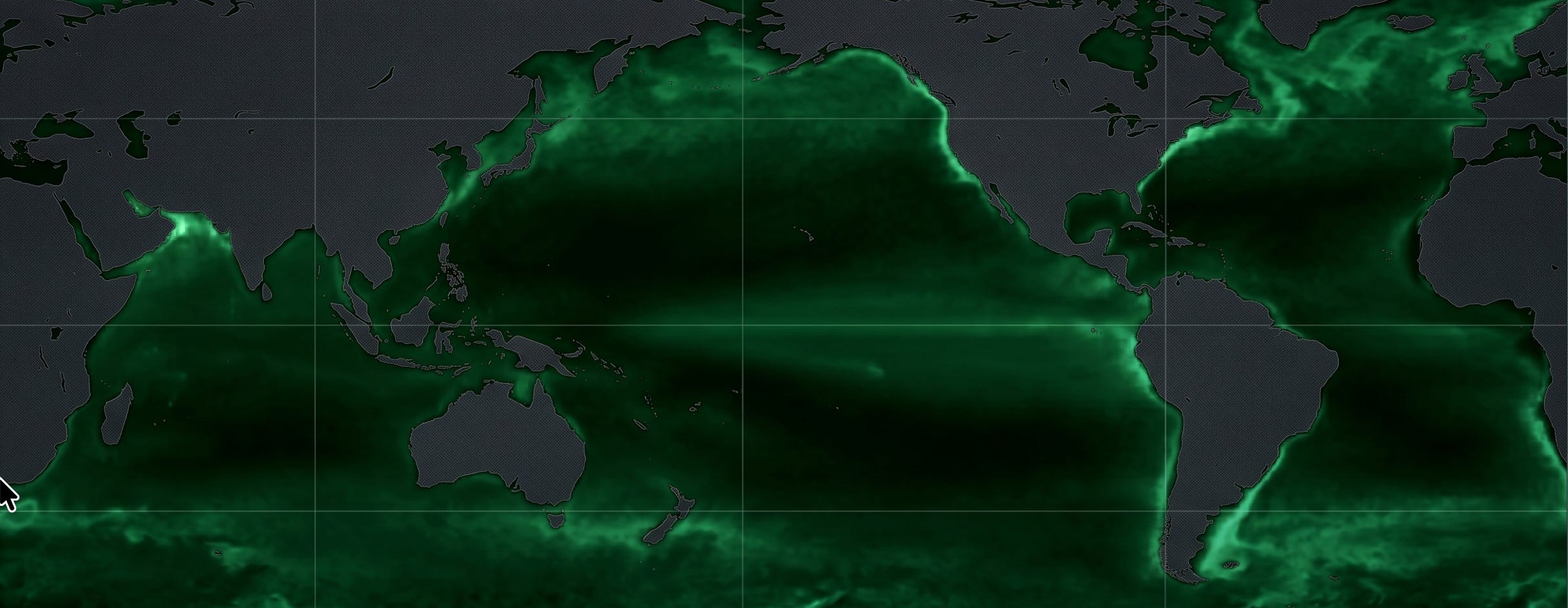
The story starts about 100 years ago, when early ocean scientists began to realize that marine life is extremely unevenly distributed across the ocean. There’s lots of life in oceans near land, but the farther out you get into the open ocean, the fewer living things you find. Get very far from a continent, towards the center of the big rotating ocean currents known as gyres, and you find yourself in a series of marine deserts: vast areas of the ocean that host almost no life.
The reasons for this weren’t really mysterious. All marine food chains begin with the microscopic plant-like organisms known as phytoplankton that first turn sunlight into food. Like all living things, phytoplankton need certain nutrients to thrive. Chief among them are two macro-nutrients: bio-available nitrogen and phosphorus.
In warm waters far from land, those nutrients just weren’t very common in the sunlit upper layer of water, so it was not surprising there wasn’t much phytoplankton. And since everything in the ocean either eats phytoplankton or something that ate phytoplankton, the absence of the nutrients they need was enough to explain why there was so little life in general.
Scientifically, the fact that the center of the ocean didn’t host much life wasn’t particularly noteworthy. The scientific puzzle was elsewhere: farther North and South some cold water oceans seemed to have plenty of nutrients. Fixed nitrogen and phosphorus was plentiful in the water, and so were micronutrients like iron and zinc, but there was very little phytoplankton, and very little life.
That didn’t seem to make sense: normally big piles of food don’t just sit there uneaten — something evolves to take advantage of untapped resources.
What became known as the High-Nutrient, Low-Chlorophyll (HNLC) anomaly became a kind of obsession for oceanographers: every time they tested the waters, they’d find a full complement of nutrients, and almost nothing eating them.
Why?
The story of how the HNLC anomaly was solved became the stuff of oceanographic legend. In the 1980s, a single, charismatic oceanographer by the name of John Martin came up with an ingenious thesis and set out to prove it. The waters in HNLC regions, Martin argued, were missing one key nutrient — it’s just that that nutrient happened to be the thing that oceanographic vessels are made of.
Because steel is mostly iron.
Martin’s insight was that oceanographers had been contaminating their own samples for fifty years, because the ships they sailed on inevitably release trace quantities of iron into the waters they were sampling. To avoid this, he designed a famously exacting new protocol to sample HNLC waters on rubber dinghies that contained no iron at all, and proved that what these waters were missing was indeed iron.
This caused quite a lot of excitement in oceanography — but I’d argue it also set the profession down the wrong track.
For the next 30 years, oceanographers became obsessed with the iron hypothesis. They commissioned more than a dozen expeditions to go to these remote areas of cold water and see what would happen if you added iron to the surface. And they found that, darn it, John Martin was right — tiny iron additions led to huge spikes in phytoplankton — HNLC regions turned out to be high in macro-nutrients, but critically lacking in a single, critical micro-nutrient: iron.
The profession’s single-minded obsession with the HNLC regions was scientifically justified. But it meant that relatively little thought went into developing the carbon capture potential of those less scientifically interesting warm oceans. Instead, the field became infatuated with the idea that you could fix climate change by adding iron to low-productivity cold HNLC waters.
Some serious researchers still think this could work. By and large, though, I’ve found most oceanographers are skeptical, because of two problems that have always hounded Ocean Iron Fertilization in HNLC waters .
The first is the durability of sequestration.
It’s easy to get a massive phytoplankton bloom by sprinkling iron into an HNLC region. What happens next is that those tiny plants get eaten by tiny animals, zooplankton. And when the zooplankton digest them, the carbon dioxide that was in the phytoplankton gets expelled right back out into the surface water, from which it soon rejoins the atmosphere. This is called remineralization, and it’s the original Achilles’ heel of ocean fertilization.
So that’s pretty concerning, but it’s not the only reason so many oceanographers are skeptical.
From the earliest days of the Iron Hypothesis, oceanographers have also worried about nutrient robbing: the idea that, in nutrient terms, iron fertilization is just robbing Peter to pay Paul.
Even if you can spark a big bloom, and even if that big bloom does capture carbon dioxide for the long term, that bloom will inevitably take up the macro-nutrients in the water — depleting the fixed nitrogen and phosphate that made the HNLC region HN in the first place. When that water mass circulates to areas of higher productivity — near a coast, say, or an upwelling zone— it will be less able to sustain phytoplankton, because its nitrates and phosphates will have been used up.
In this view, all iron fertilization does is change when and where phytoplankton develops, not how much. In some sophisticated versions of this argument, nutrient robbing could turn fertilization into a net ecological negative, with potentially serious impacts on downstream fisheries.
There are other, more niche concerns too about deoxygenation and nitrous oxide production. But remineralization and nutrient robbing are the concerns that oceanographers bring up every single time.
Look closely, and you see these are not objections to ocean fertilization in general.
They’re objections to one specific approach: cold water Ocean Iron Fertilization in HNLC regions.
The vast bulk of the world’s marine deserts, however, are not in high-nutrient, low-chlorophyl parts of the ocean. Most marine deserts they’re in warm sub-tropical ocean gyres, which are classic low-nutrient, low-chlorophyl (LNLC) waters.
Ocean fertilization, but not as you know it
Way back in the 1980s, a tiny band of contrarian oceanographers started arguing that HNLC might not be the best target for fertilization. Centered around a handful of researchers at the University of Southern California, they began to build the theoretical foundations for an alternative approach, one that promised to sidestep remineralization and nutrient robbing issues by centering on an entirely different approach, in an entirely different kind of ocean regime.
Granted, at first sight, trying to make low-nutrient oceans fertile seems like a terrible idea. Unlike HNLC regions that just need miniscule, trace quantities of iron to sustain photosynthesis, LNLC regions are missing macro-nutrients: the major building blocks of life. They often have almost no nitrates and are low on phosphates too, and here we’re not talking about trace quantities, we’re talking about massive amounts of complex molecules. This sparks nightmare visions of large chemical fertilizer plants burning natural gas to run Haber-Bosch nitrogen fixation. The logistics of that are daunting, and the economics beyond hopeless.
Except, there’s another way.
Gardners have known for years that you don’t necessarily need a chemical plant to fix nitrogen, you can also do it with a bean stalk. Beans host microbes around their roots that have evolved to catch inert atmospheric nitrogen (N2), break up its triple bond, and fix it into the kind of fertilizers plants need to grow. Turns out there are bugs in the ocean that do the same thing. A key paper in opening this discussion was this 1982 beaut by Doug Capone discussing trichodesmium, an ocean microbe that runs the same biochemical pathway and fixes nitrogen in the water exactly the same way the bugs that live on beanstalk roots do on land.
This whole thing about nitrogen-fixing microorganisms seemed of, at best, academic interest until scientists identified this process operating in nature.
The breakthrough came courtesy of research into hydrothermal vents. In the South Pacific, off the coast of Tonga, you find these undersea volcanoes that are actually quite shallow. Shallow enough that the plume of minerals they put into the water reaches the sunlit layer of the ocean, the bit where phytoplankton grow.
The darn things are running a picture perfect natural experiment on what a warm water fertilization program might do.
The vents demonstrate that adding nutrients to the upper ocean does exactly what you would wish: it captures an enormous amount of carbon dioxide. How? By turning Low-Nutrient waters into High-Nutrient waters. And how do they do that? By feeding the bugs that capture N2 from the air and fix it into bio-available form.
It’s an incredibly cool finding, and one with major implications for iron fertilization in LNLC regions. Because —and this is the message that even most Oceanographers seem not to have quite grasped yet— LNLC fertilization addresses both of the major criticisms against HNLC fertilization.
Remember, HNLC fertilization gets slammed for nutrient robbing: the idea that fertilized patches just soak up the pre-existing stock of macronutrients, depriving downcurrent communities of those nutrients. But Nitrogen Fixation based approaches certainly don’t do that: NFix adds new macronutrients to the ocean.
The newly fixed nitrogen that’s driving phytoplankton growth around these vents sites isn’t being stolen from downstream communities, it’s been newly fixed straight from the air. And while you can’t fix phosphate from thin air the way you can fix nitrogen, many lines of research suggest phytoplankton can stretch their phosphate budgets much farther than they can stretch their nitrogen. In other words, if there’s not enough fixed nitrogen, phytoplankton just don’t reproduce. But where there’s not enough phosphate, in many cases they adapt and keep growing. (There are limits to how far they can stretch a limited phosphate budget, of course, but those limits are a lot less stringent than for nitrogen.)
Then there’s remineralization: in cold HNLC waters, when the phytoplankton gets eaten, the whole system just stops and the CO2 goes right back out to the air where it started. When you add fixed nitrogen, though, the picture changes: when a zooplankton eats a phytoplankton, it’s not just the CO2 that gets remineralized, it’s also the fixed nitrogen! That ends up right back in the water, where it drives a whole new cycle of phytoplankton fertilization. Oceanographers call this regeneration, and to them, it makes perfect sense. In a nitrogen-limited system, which is what LNLC waters are, the organisms in the water are desperately hungry for fixed nitrogen. This is what makes LNLC different from HNLC: in HNLC systems, pools of fixed-nitrogen just sit there, unused, on the ocean surface for lack of iron.
In LNLC systems, any fixed nitrogen that hits the water is quickly consumed to regenerate phytoplankton. In this kind of ocean regime, remineralization is unlikely to end up re-emitting CO2 to the atmosphere. Instead, it just becomes part of the regeneration cycle.
And there are other subtler reasons to think LNLC oceans may do better at long-term carbon storage than HNLC regions. The warm waters where LNLC conditions develop are thermally stratified: a relatively warm layer sits on top of the water column. As it’s less dense, it acts as a lid on the system, preventing deep mixing. This tends to counter the tendency of carbon that has been captured from rising back up to contact with the atmosphere. Less deep mixing also means the surface waters have more time to equilibrate their CO2 content with the atmosphere, which theoretically ought to improve sequestration efficiency.
Still early days
If you’ve read this far, congratulations! You now have a better grasp of next generation ocean fertilization techniques than most oceanographers.
Does this mean that Nitrogen-Fixation based fertilization will definitely work as a carbon capture pathway?
Hell no!
We have years of scientific research to do before we can design a workable deployment protocol. There are definitely risks — it may be that we run out of phosphates faster than we expect, it may be that we deoxygenate the water column more quickly than we realize, it may even be that we select for harmful algal blooms, or increase the production of Nitrous Oxide in the ocean.
There’s quite a lot of careful work still to be done before we can really say NFix will work at scale, and we’re not taking anything for granted.
What I can say from direct experience is that every scientist working in this field is very well aware of the risks, and committed to researching this pathway responsibly. People outside the field sometimes get the sense that the people who are into fertilization are a bunch of cowboys, in my experience, it’s more like a small group of very sane professional oceanographers who’ve spent their entire careers studying the ocean and are very aware of how precious these ecosystems are.
They’re also very attuned to the risks of runaway climate change, though, and understand that it makes no sense to obsess about one set of risks while ignoring the other.
I’m excited about these new fertilization approaches because it seems like it could work and I think if we do it carefully, we can do it safely — but I know that’s a far cry from proving that it will work and it is safe.
Still, the takeaway here is that the vague sense in the climate world that Ocean Fertilization is off the table needs to be revised. That view developed around one particular fertilization approach.
Because it’s a big old ocean, and most of it is not cold waters around Antarctica or near Alaska. Most of it —around half the surface of the earth— is sub-tropical waters that don’t have a lot of nutrients and don’t have a lot of phytoplankton.
It may be that a relatively simple, cheap, ecologically benign intervention to rebalance the nutrient profile in those waters can vastly increase the ocean’s ability to absorb carbon dioxide safely. It may be that a simple, low-cost, ecologically benign intervention can stop climate change in its tracks.
Once you see it, it’s hard not to be excited about it.
The key thing you are trying to achieve is fixing carbon. That is net conversion a kg of atmospheric carbon into two kg (dry wt) of biomass, which sinks to the bottom.
The four biggest components of biomass are C, H, O and N. Water provides the H and O, and CO2 provides the carbon. For cyanobacteria, atmospheric nitrogen provides the N. For other phytoplankton, nitrate that leaks out of the cyanobacterial provides the N.
But biomass also contains other components, P, S, Mg, Fe, Co, and a bunch of other minerals, which they need to get in their diet, just as we do. Phytoplanton contains a lot of diatoms, so silica is also a nutrient (but this may simply be because hydrovents contain a lot of silica, so you get a lot of diatoms). We are talking a natural process--we aren't in a bioreactor, where we have better control over things--so things are going to be complicated.
SO for every ton of carbon you sequester you will need to provide some of these other nutrients, Phosphorous likely, and certainly iron. Perhaps others. You can figure you will need about 1 kg of phosphorous for every 50-100 kg of carbon you sequester. There's plenty of sulfur in seawater so that's not problem.
Thank you for this post. Fascinating and new to me, although I've been paying some attention to carbon removal technology since I wrote an article (and then a short book) about direct air capture of CO2 for FORTUNE magazine in 2011. I'm sure you know that there was a startup company called Planktos that intended to make a business out of ocean iron fertilization at about that time. I hope that in a future post you will write about (1) the costs of this technology and (2) the business model, if any, for bringing it to scale and (3) the politics. Surely there will be opposition from environmentalists but by now I hope that the more mainstream green groups recognize the need for CDR.