

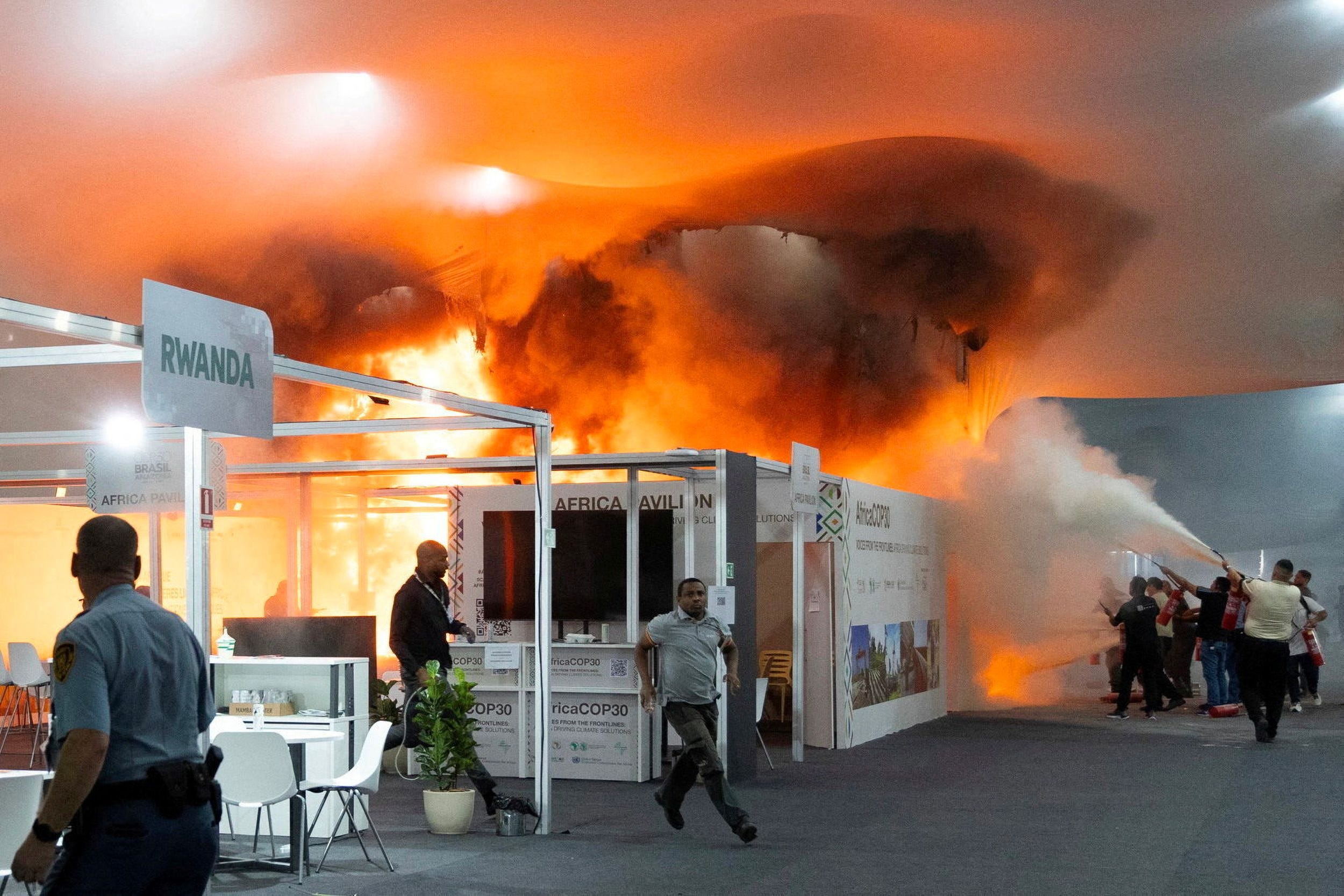
Last week in Davos, my Prime Minister, Mark Carney, signed the death certificate for the rules-based liberal international order. Climate people are greeting his rupture speech with a sickened knot in their stomach. For three decades, they built their entire response to climate change on the assumption that something like the post-1945 settlement was permanent.
That order is no more.
In an upsetting but necessary piece in The Atlantic, Robert Kagan warns that the resulting multipolar reality is “one that will make the Cold War look like child’s play and the post–Cold War world like paradise.” Without a hegemon keeping the peace, and with Russia and China on the prowl, every middle power gets forced back to prioritizing security. Re-arming is expensive. In a world where Germany has to spend 4% of GDP on defense and Poland and South Korea are quietly building nuclear weapons, who exactly is going to care about emissions? Energy security trumps emissions every single time. All that stuff about “ratcheting ambition” already reads like an artifact from a lost era.
In Climateworld, the temptation is strong to just pretend like none of this is really happening. Fingers firmly plunged in ears, “naaa-naaa-naaa”s bellowing, they’re still going to turn up at the next COP like the old world still exists. The entire UN Framework Convention is likely to go the way of the World Trade Organization: a zombie institution that’s still there on paper but doesn’t actually do anything of relevance.
Let me say something heretical: the zombification of COP may be just what the climate space needed. Because even when it “worked,” the UN climate beast didn’t work. And not just because everything the UN touches turns to ossified bureaucracy, but because the focus was wrong from the start.
The UN system thinks of the climate problem as chiefly about mitigating emissions and, secondly, about helping poorer countries out if emissions can’t be brought down fast enough. That whole way of thinking made sense back in 1992, when atmospheric CO₂ concentrations were at 350 parts per million and the whole dog-and-pony show got on the road. It’s been losing relevance ever since. Now that atmospheric CO₂ is 430 ppm and the rise is still accelerating, we should stop pretending. It seemed like a good idea. It failed. We need something better.
We spent 30 years waiting for everyone to agree to do something serious about climate change. Everyone didn’t agree. The UN Process delivered exactly what it was architecturally destined for: the most aggressive climate agreement Saudi Arabia will sign on to. Doubling and tripling and quadrupling down on that mechanism was never really a sensible strategy in the first place.
Still, there was a kind of isomorphism between the UN Framework’s architecture and the emissions-reductions-first view of climate change. Carbon emissions all end up “well mixed” into the same atmosphere, wherever they came from. If your strategy centers on curbing emissions, multilateral cooperation is absolutely needed.
But what if we flipped the script? What if we shifted focus to removing the carbon dioxide that’s already in the atmosphere?
Well, then we’d get a very different dynamic. The opposite dynamic, in fact. Because you don’t need global agreement to capture carbon dioxide at scale. With emissions mitigation, unless everybody does it, nobody benefits. With Carbon Dioxide Removal if anybody does it, everybody benefits.
It means shifting from a world where everybody is a veto player to a world where nobody is.
Really, all you need is one place willing to give climate-scale CDR a chance, and some jurisdiction willing to pony up the cash. If you can bring CDR costs down to the $10 per ton range, it wouldn’t even be that much cash—certainly much less than we’re spending now on a path that doesn’t work.
The question, really, is whether carbon dioxide removal can be brought to scale at that kind of price.
My sense is that people gave up on CDR far too early. Marine carbon dioxide removal in particular has obvious potential to get us there, if only because the ocean already holds nearly 100 times more carbon dioxide than people have ever put into the atmosphere. Much, much more research ought to be going into these responses.
When the multilateral route commanded a consensus, people resisted talk about climate-scale CDR simply because it seemed to detract from the universality the UN approach demanded. This came phrased as concerns about moral hazard: “you can’t take carbon dioxide out of the atmosphere, because that just gives polluters excuses to keep putting more in!”
Once we process the rupture in the multilateral order we’re living through, the intelligent calibration is to double down on much better CDR: much cheaper, much safer, much more scalable and, of course, ecologically benign.
This is what I spend most of my time working on: specific marine carbon dioxide removal mechanisms that could turn this conversation on its head. Scientists are working on this problem as we speak. If we reorient climate action around supporting their efforts, and if we’re willing to think outside the box, we might actually be able to address climate in a multipolar world. Not because it’s easier, but because we’re finally free to pursue what works instead of what everyone can agree to.
It’ll take a few years. But we can do this.
This is exactly the kind of thinking that I turn to you for, I will be sharing this with my family and friends.
Extremely impressive thinking.
I really hope you get the support you need.
Thank you
The US base of Trump has been alternately trembling and cynically acclaiming the coming of the Rapture. Alas, it was a typo.