

At New York Climate Week this year, the king of the buzzwords was clear: Earth Energy Imbalance.
Well, at least it was for me. New York Climate Week is a vast event: the buzzword you hear most often says something about the corner of the Climate Blob you choose to call home. For people like me minded to zoom out and take the global perspective, Earth Energy Imbalance is becoming the organizing principle for a new way of thinking about the climate.
The concept joined the ranks of official climate indicators just this year. In June, it was included in a landmark World Meteorological Organization report, which defines it as “the difference between the amount of energy the Earth receives from the Sun and the amount of energy the Earth radiates back into space.”
In a way, the concept is not new at all. It brings us right back to the very basics, to middle-school textbook diagrams like:
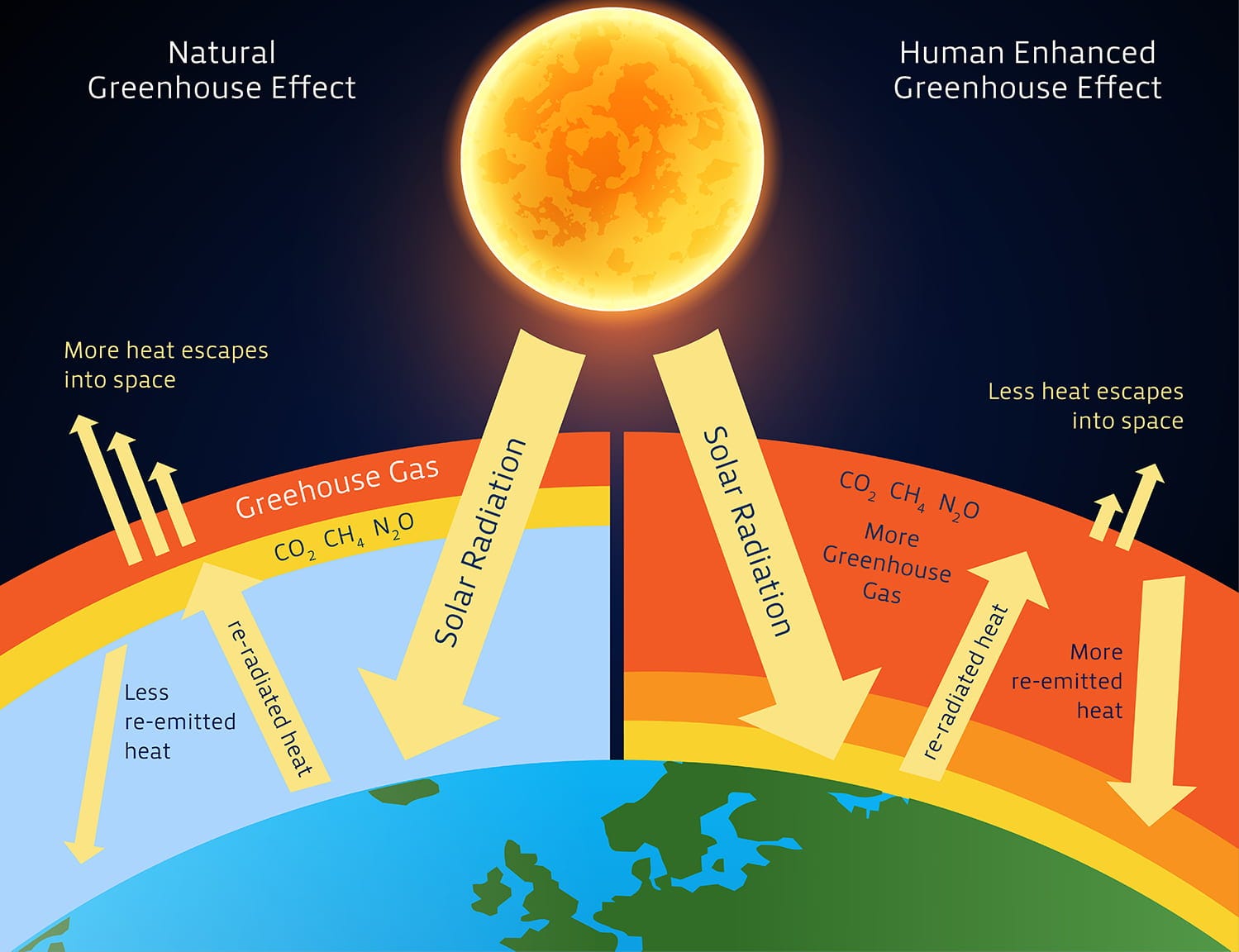
The takeaway we give schoolkids is simple: greenhouse gases (GHGs) create an imbalance in the Earth Energy Budget by trapping heat in the atmosphere, rather than letting it escape into space.
Which is true, of course. But incomplete. And not just incomplete: deeply misleading.
Because notice what’s missing from this diagram. What’s not there?
Clouds. And polar ice caps. The things that cause heat to bounce off into space.
It turns out greenhouse gases aren’t the only variable in the Earth Energy Balance equation. Reflectivity —albedo, in the lingo— is also changing.
And as I heard again and again last week, it’s not just changing: it’s sort of in free-fall. When we first got high-quality satellite data on how much of the energy from the sun bounced off into space, back around 2000, it was about 29.4% of the total. Now it’s down to about 28.6%.
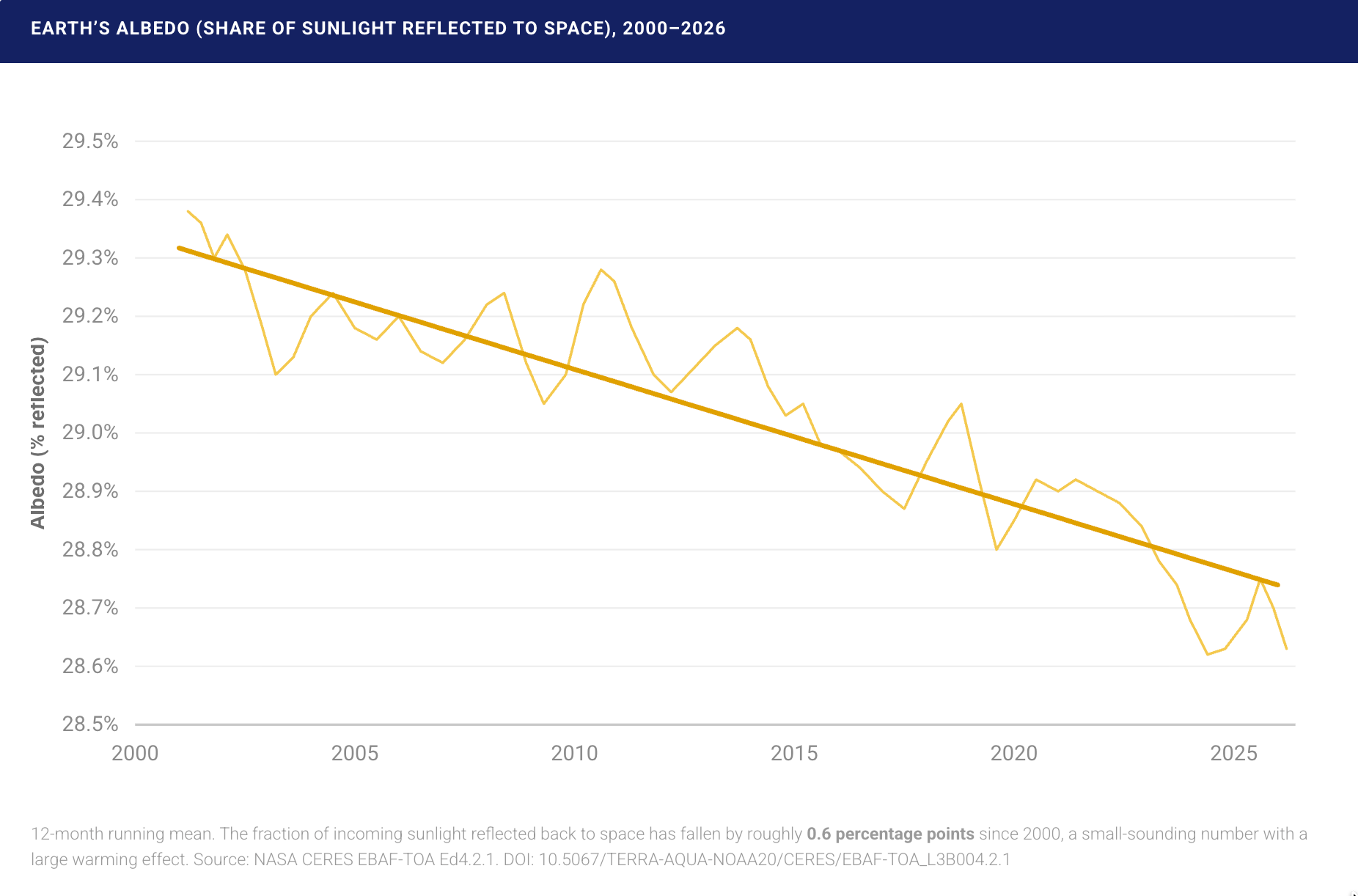
That may not sound like a huge shift, but it is. Phil Duffy, Chief Scientist at Spark Climate Solutions, calculates that “the warming influence from Earth’s declining reflectivity is roughly equal to that from the greenhouse gas effect of all human carbon dioxide emissions since 1750.”
Why is the Earth getting less reflective? This is a hot question.
In part, it’s because we’re losing ice and snow cover. And why is that? Because temperatures are rising — this is one of those self-reinforcing loops that tend to give climate scientists the heebie-jeebies, because you can just about imagine them spiraling out of control.
But the bigger reason seems to have to do with clouds. We have fewer of them, and the ones we still have —especially low clouds over tropical oceans— are duller.
The reasons for that are themselves contested. In part, cleaning up air pollution has taken away a major source of cloud condensation nuclei, leaving us with duller clouds. But other researchers believe there’s some as yet not-well-specified feedback loop connecting a hotter atmosphere with duller clouds.
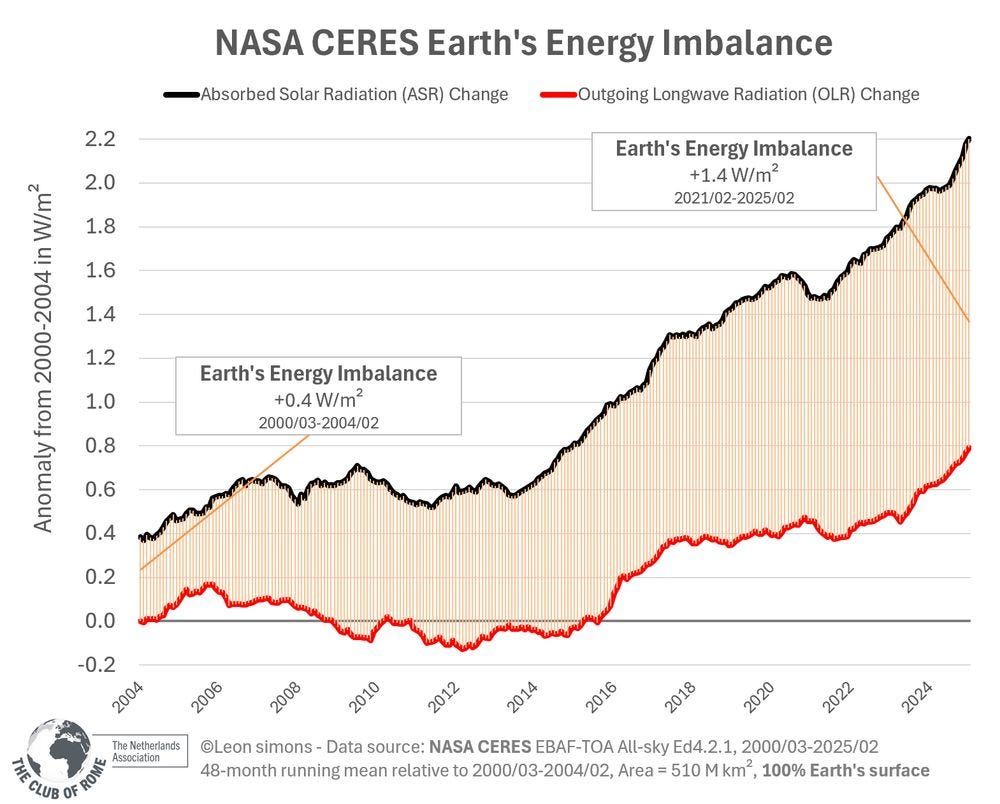
Part of the problem is that we only have about a quarter of a century of really good data on Earth’s Energy Imbalance, all coming from the wicked cool Clouds and the Earth’s Radiant Energy System (CERES) satellites NASA and NOAA put into orbit starting in 2000. In that time, Earth’s Energy Imbalance has tripled, going from an average 0.4 watts per square meter at the start of the century to 1.4 W/m2 on average over 2021-2025.
That’s a huge shift, and it explains the apparent paradox where global temperature rise appears to be accelerating even though greenhouse gas emissions aren’t growing anywhere near as fast as people feared they would just a few years ago.
The traditional way we teach schoolkids to think about climate change doesn’t leave them prepared to make sense of the changes the atmosphere is facing.
The simplified mental model we all carry around in our heads where “greenhouse gases are responsible for global warming” is a half-truth. The startling reality is that the planet is getting hotter due both to increasing GHG concentrations and a sharp decline in planetary reflectivity.
This is a message that the more traditional part of the Climate Blob isn’t ready to hear. Albedo is hardly ever talked about in UN climate negotiations. The mainstream climate movement continues to act as though the only driver of Earth Energy Imbalance were increasing GHG concentrations.
I left New York Climate Week substantially more worried than I was going in. The failure to grapple with the implications of collapsing Earth reflectivity is quickly becoming its own form of climate denialism.
Declining albedo is a huge political can of worms that the movement doesn’t want to open. Fighting the fossil fuel industry is the comfort zone for much of the movement, and getting serious about albedo breaks down the easy moral certainties. It forces you to wrestle, for instance, with the idea that cleaning up pollution can both improve people’s health and accelerate global warming, by taking away a source of reflectivity. Earth Energy Imbalance puts the spotlight on tradeoffs and contradictions the movement would prefer did not exist.
What this all builds up to is the staggered realization that even if you could wave a magic wand and stop all anthropogenic emissions tomorrow, that would not be enough to solve the problem.
In the U.S., half the political sphere is in denial about climate change, writ-large. The other half —who are supposed to be good guys— is in denial about half of the problem.
Only a tiny fringe, clustered around a handful of non-profits, NGOs and research labs, is really ready to grapple with Earth Energy Imbalance as a whole.
For guys like me, who spend all our time thinking about how to reduce greenhouse gas concentrations in the atmosphere, learning to think in terms of Earth Energy Imbalance is tough. It suggests that even the kind of maximalist carbon dioxide removal approach I’ve long favored may not be enough to address the climate shitshow we’ve caused. That doesn’t make gigaton-scale CDR less important, but it shifts it into the “necessary but not sufficient” space. Nobody likes that space.
The founding premise of my substack, though, is that uncomfortable realities are better faced than ignored. Let’s.
I’m trying very hard to quell my naive optimism and be more worried with you. But doesn’t this mean albedo is a new, as-yet-unexplored, major avenue for fighting climate change?
How ignorant is it to start daydreaming about new tactics like strategic, intentional pollution or cloud seeding to get more, bigger, brighter clouds? Big ole mirrors? Desertification?
I recognize the scary feedback loop potential and that albedo issues seem downstream of carbon issues. But if the albedo fight is in its infancy, shouldn’t we be excited to open a new front in the climate war given the stagnation on greenhouse emissions?
The climate models do not place much of a weight to the biogenic cloud nucleation aerosols lost in deforestation. Also, the droughts causing further deforestations. The aquifer collapse. The river/ glacial water feeds.
Time to get real.