

Discussing climate change is frustrating, because people come to the problem at very different levels of sophistication.
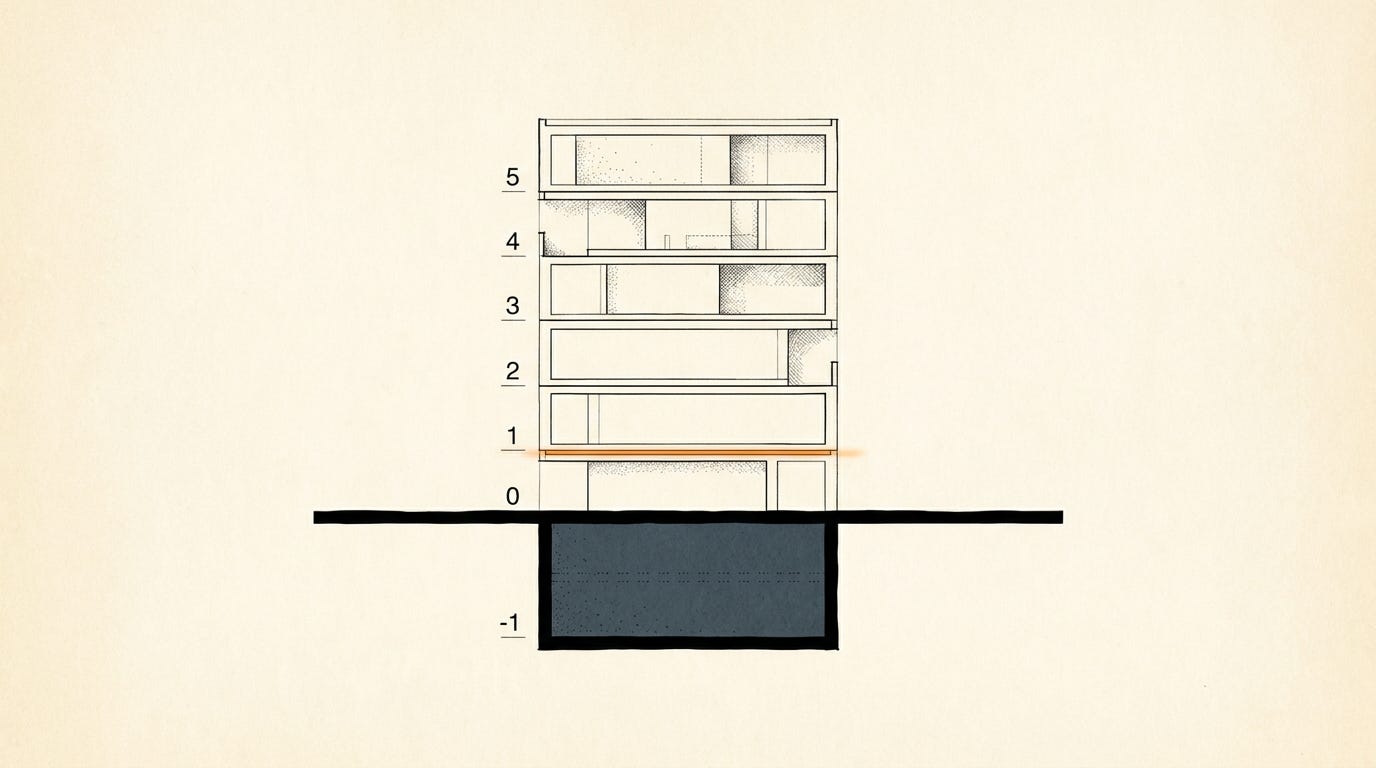
The way I think of it, there are seven levels of climate engagement.
Climate conversations go off the rails mostly because it’s hard to establish communication between different levels. Maybe it would help if we named them.
Level minus-one: Denial
One in nine Americans thinks climate change isn’t a thing; another 11% or so are “doubtful.” In Yale’s long-running tracking survey, those shares have barely moved in a decade. Europe doesn’t have a MAGA-sized denial bloc: in most EU countries the doubtful and dismissive together come to around 10%. These people are scientifically illiterate and intent on polluting the public sphere. They should be ignored.
Level zero: Disengagement
A much larger group sees climate as not their problem. In that same Yale survey, 47% of Americans say they’ve thought about global warming “a little” or not at all, 65% rarely or never discuss it with family or friends, and a third say they never hear anyone they know bring it up. In the UK, about a fifth of the population falls into segments researchers label “disengaged.” Overall, 13% of Britons report no emotions about climate change at all.
To these folks, climate is like the opera: an elite preocupation, nothing to do with them.
This isn’t denial. You have to think about climate change in order to deny it, and lots of people just don’t. Which is ok. Everyone has a right to choose which public matters to take an interest in, and at least the disengaged aren’t injecting nonsense into the public sphere. They’ve decided to spend their limited attention elsewhere — which, considering the state of the debate, could be taken as evidence of good judgment.
Level One: Climate as Lifestyle Brand
One level up, you get people who think of climate as bikes vs. cars, organic vs. conventional agriculture, recycling vs. littering, going vegan vs. eating meat. This is climate as consumer lifestyle. It’s the environmentalism taught in schools, and there’s nothing wrong with it, exactly. There are really good reasons for riding bikes and recycling and eating vegetables, they’re just not climate reasons.
As climate engagement, level one is shallow and ineffective. It treats a problem of planetary energy balance as a question of personal virtue, as if consumption choices that amount to rounding errors in the global carbon budget were the main event. Level one demands nothing of any system, it’s all about you. Perfect for a narcissistic age.
This is where consumers are, by and large. And where consumers are, corporations follow. Level one is the natural habitat of the greenwashed brand: “carbon neutral” labels backed by iffy offsets, airline ads about flying responsibly, sustainability pledges that end up meaning nothing much in practice. It was BP’s ad agency that popularized the “personal carbon footprint” in the first place, and for the same reason companies sell all level-one products — a public fixated on its own consumption choices is a public not looking at anything upstream.
If I mention casually that I work on climate, people tend to assume I work for a level one sustainability thing. Which figures: to normies, level one is by far the most visible form of climate engagement. It’s not interesting.
Level Two: Climate as Activist Politics
One level up, you find climate as activist politics. This form of engagement is marked by a naïve conviction that decarbonizing electricity via solar and wind energy can fix the climate, and that this would happen if only evil oil companies and nasty conservatives didn’t get in the way.
Climate as activist politics is a first world preocupation that too often turns into an extension of the culture war. It treats scoring political points against ideological foes as the point of climate activism. It collapses a global, century-scale problem into a national political question.
The arithmetic would put an end to it, if first world climate activists had any interest in arithmetic. The United States now accounts for about 13% of global fossil CO₂ emissions and the EU about 7%, both falling, while China emits 32% and India, growing at nearly 5% a year, has already passed the EU.
Electricity, the sector that soaks up most of the activist oxygen, is only a fraction of the problem; industry, transport, buildings and agriculture are together much larger. Still, level two treats a coal plant permit in Ohio or a heat-pump subsidy in Germany as though the fate of the biosphere hinged on it. You could win every last one of those fights and you’d have solved maybe a fifth of the problem — the fifth that was already shrinking on its own.
You can spot level two conversations instantly by their insistence that climate risks are imminent. The tell is in the vocabulary: “climate crisis,” “climate emergency,” “climate breakdown” — language The Guardian wrote into its style guide in 2019, and which more than two thousand governments have since echoed in official climate emergency declarations that obligate nobody to do anything. The theory is that people can’t be mobilized unless the stakes feel immediate, so immediacy gets asserted whether or not the science supports it. Mostly it doesn’t: the genuinely catastrophic outcomes are the ones we’re saving up for our great great grandchildren.
Overheated level two rhetoric has a way of backfiring. German panel studies tracking climate attitudes from 2015 to 2023 find the disengaged and skeptical segments growing since 2019, a backlash the authors chalk up to climate fatigue and frustration with green policy. In the UK, more than half of the working-class “Disengaged Battlers” — people who fully accept the science — agree there’s “no point trying to protect the environment because big companies will keep polluting anyway.”
This hangover is level two’s real legacy: disenchantment, leading to disengagement. People tune out a discourse both apocalyptic and parochial, screaming that the world is ending while fighting about municipal bike lanes. Level two is a waste of time.
Level Three: Climate as Anti-Capitalism
One level up, the conversation is all about degrowth. This is a much smaller conversation than the one at level two, but it’s more sophisticated in one respect: it recognizes that the problem is systemic and global, not a matter of light bulbs and shopping bags.
If you’ve read Jason Hickel or Giorgos Kallis, or if you happened upon the European Parliament’s “Beyond Growth” conference in 2023 with commissioners in attendance, you have some sense of level three. The diagnosis deserves credit: climate change really is a function of the globalized economy as a whole, not of any one sector or bad actor. The problem is that their remedy is uniquely awful — a tankie pipe-dream that would devastate billions of livelihoods if it were ever enacted. Which, to be clear, it never will be.
Of the many things degrowthers are in denial about, the most flagrant is that we already ran the experiment. In 2020, COVID shut down aviation, commuting and a good chunk of world commerce — the most abrupt contraction of economic activity ever recorded — and global emissions fell by about 5%, for one year, before snapping right back. And everyone hated it. Hitting the Paris targets through contraction alone would take a shock of that size every year for decades, imposed voluntarily, on people who have proven over and over that they’ll riot over a fuel price hike.
The deeper premise — that growth and emissions are welded together — is just wrong. Some three dozen countries, the UK and most of the EU among them, have been cutting emissions in absolute terms for decades while their economies grew, even after accounting for offshored production. Britain’s emissions are roughly half their 1990 level; its economy is far larger.
Degrowth is a first-world sensibility gaslighting itself as a revolutionary program. You cannot degrow eight billion people to net zero, because six billion of them are still poor and have made it perfectly clear they intend to get richer — as is their right. The average Indian emits a seventh of what the average American does; hundreds of millions of people still have no electricity at all, and billions more want the air conditioning, refrigeration and travel the degrowth theorist already enjoys. No government on Earth, democratic or otherwise, is going to enact a program of mass immiseration. Obviously.
Level three gets the scale of the problem right and then prescribes a cure the patient will never take, because taking it would kill him. Its main output is the moral comfort of its adherents.
Level Four: Climate as Earth System Science
Level four begins with the recognition that greenhouse gases are not the whole story of how humanity impacts the climate: albedo matters too. This is climate as science — carbon cycles, aerosols, feedbacks.
You can tell someone is at this level because they know the lingo of radiative forcing: only monster climate nerds think in watts per square meter.
Consider a fact that almost never surfaces below level four: our own air pollution has been cooling the planet, masking something like half a degree of the warming our greenhouse gases have already bought. When the International Maritime Organization forced ships onto low-sulfur fuel in 2020, it inadvertently ran a planetary-scale experiment in removing part of that sunshade, and scientists have been arguing since about how much of 2023–24’s freakish ocean heat traces back to cleaner shipping lanes. We’ve been geoengineering the Earth for a century by accident. Level four is where people ask what it would mean to stop doing it by accident.
This is where the serious climate conversation begins, in a handful of research facilities and university labs. The debate on solar radiation management happens here — no longer as a taboo but as an empirical question, now that the UK’s ARIA has put £57 million into climate-cooling research, including the first government-funded outdoor experiments. The sobering arithmetic of carbon removal happens here too: the world currently removes about 2.2 GtCO₂ a year, 99.9% of it by planting trees, while the “novel” methods that would have to do the heavy lifting remove about 2 million tonnes — against the 6–9 gigatonnes the 2050 scenarios require.
My day job, supporting research on the biological pump that moves carbon into the deep ocean, is pure level four. Phytoplankton run roughly half the photosynthesis on Earth and export gigatonnes of carbon a year into the abyss, a flux that dwarfs anything human engineers have built and that we barely monitor, let alone control. If we could master this mechanism, we could get out ahead of the worst outcomes of climate change without disrupting the economic systems billions of us rely on. It’s worth a try, anyway.
And level four is where the conversation on tipping points — the ice sheets, the permafrost, the Atlantic circulation — lives, with the unglamorous question of what it would take to keep them un-tipped.
There are no villains at level four. Climate is treated like a set of physical flows you can measure, model and, perhaps, deliberately manage. Greenhouse forcing, aerosol masking, the albedo of clouds and ice, the ocean’s carbon pump — terms in an energy budget, not a morality play. Which is why level four stays small. Posturing in favor of science is morally satisfying, actual science is morally unsatisfying. There is no constituency for energy balance.
Level Five: Climate as Intergenerational Geostrategy
An even more esoteric level of debate, level five recognizes that the ultimate stakes in the climate fight are intergenerational and geostrategic: which generations, in which parts of the world, will pay the costs?
Level five looks squarely at a fact levels one through three mostly suppress: the deep-future impacts of climate change are likely to be much worse than anything coming in the next three to six decades. The physics here is unambiguous. Warming is effectively irreversible on human timescales, and the sea-level commitment we’re locking in now plays out over millennia — multiple meters per degree, long after the last coal plant closes. The 2050s, which level two treats as the apocalyptic horizon, are the shallow end of the damage curve. Once you take that seriously, the policy problem changes shape. The question is no longer “how do we avert catastrophe in our lifetimes” — mostly, we will — but “what does the present owe centuries it will never see?”
That question hinges on one of the most consequential, least understood variables in climate: the discount rate — how much less a life counts for being born later. If you set the discount rate near zero, as the Stern review does, you conclude we should spend heavily now. When William Nordhaus ran the same models with market-derived rates, the urgency largely evaporated. Nordhaus got a Nobel for his version; Stern got a peerage for his. The difference between them is a philosophical judgment masquerading as a decimal hiding in an equation.
Martin Weitzman later showed that fat-tailed catastrophic risk can break the cost-benefit machinery altogether. This is the territory of philosophers like Joseph Heath, whose Philosophical Foundations of Climate Change Policy treats climate as what it is — the hardest intergenerational coordination problem humanity has ever set itself — and of John Broome and the longtermists, who ask in earnest what a civilization owes a future it instinctively discounts.
At level five, the conversation isn’t scientific, it’s philosophical and moral. It’s about the injustice of letting the costs of warming fall first and hardest on the tropics, on countries that emitted almost nothing historically, while the levers of any deliberate response sit in Washington, Brussels and Beijing.
Then, when we realize that the technology to set earth’s temperature for human ends is within our grasp, the question is whose hand gets to set the thermostat, and on behalf of which century, will become central. That’s the endgame question of climate politics, and you could read The Guardian cover to cover day in and day out and never hear about it.
I aim to spend my time at level four, with occasional awestruck visits to level five. But I can’t help but notice that the vast bulk of what people understand as “climate debate” happens farther down the structure. And that’s a shame.
If this taxonomy has a point, it’s this: when someone bores or enrages you about climate, they’re probably just engaging at a different level, and the cure isn’t to argue harder — it’s to invite them to climb. The view improves at every level, and there’s plenty of room at the top.
Hi Quico. I always enjoy reading your blog, even when I disagree with parts of it. I found this piece particularly interesting because I take a somewhat similar approach when teaching my environmental economics course. That said, I felt the argument was rather one-sided and omitted some important considerations.
I broadly agree with the first two "levels", but I think public disengagement with climate change is more complex than simply reacting against climate activists. Climate change is a long-term, abstract issue, while most people are focused on immediate concerns. After years of constant media coverage, many have simply tuned out. Climate activism may contribute to disengagement, but I doubt it is the primary cause.
I was also unconvinced by the claim that only our great-great-grandchildren face catastrophic climate risks. Much depends on how "catastrophic" is defined. For those already experiencing deadly heatwaves and floods, catastrophe has arguably already arrived. More importantly, the scientific literature suggests that several potentially catastrophic outcomes, such as coral reef collapse, Amazon dieback, or major AMOC disruption, could occur this century. These risks remain uncertain, but they make it difficult to confidently claim that only distant future generations are at risk.
The biggest omission, however, is the mainstream net-zero/sustainable growth perspective. The piece moves from climate activists to de-growthers without acknowledging the dominant view in climate science and economics: extensive electrification combined with decarbonised electricity systems. Whether this ultimately succeeds remains uncertain, but it is backed by a substantial body of research. Given how central this perspective is to the debate, its absence felt strange.
More generally, I came away feeling that the piece presented your own position as the only enlightened one, with all others dismissed. Given the deep uncertainties surrounding this issue, such confidence seems difficult to justify, including with respect to the solution you favour.
Hey Quico, this is great -- I think I might use it on the first day of my course on climate change. However, I would add one level between 3 and 4. This would be something like the "climate technocrat" level, which focuses exclusively on mitigation, and understands the superiority of pricing instruments over traditional command-and-control regulation. Personally, I find that this is the largest, hardest "leveling up" for students -- they need to get over the deontological mindset ("pollution is bad, we should ban it"), realize that it's an optimization problem ("how much GHG should we be emitting?"), get past all of the moralization objections to pricing ("it commodifies nature"), and figure out why permit trading and carbon taxation are equivalent policies. This is the level at which most people involved in serious policy debates find themselves (I think of the Pembina Institute as typical: https://www.pembina.org/). This is still not your level 4 though, because of the overwhelming focus on mitigation. The level beyond involves thinking more seriously about adaptation, SRM, NET, sequestration, as well as situating climate change in a basket of other issues.
Also, I should mention that I find myself somewhat self-conscious about having made my major contributions at level 5, precisely because it's not the most helpful level to be at, in terms of solving the actual problem at hand. The discounting issue is neat because it's the one point at which the very deep philosophical questions, about what it means to treat future generations fairly, intrude into the policy debates. But you don't want to hold policy hostage to the resolution of these deeper questions. So the "level" metaphor falls apart a bit between 4 and 5, because you don't want to imply that people at the higher level are necessarily seeing things more clearly.