

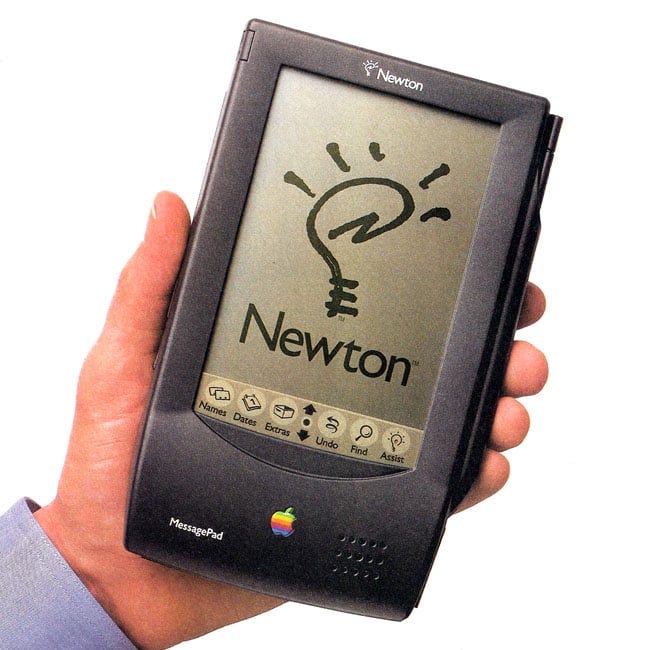
Look at this bad boy.
It’s the Newton.
Apple launched it in 1993. Nerds and analysts ranted and raved about it. It could recognize your handwriting! It could keep your calendar and your contacts! To a lot of people at the time, this was the future. But this wasn’t the future.
Camera? Sharight. The Newton could not connect to the internet, because there was no internet to connect to. It was a complete failure commercially. The iPhone would come along fourteen years later, wipe the canvas clean, and establish a new paradigm.
Carbon dioxide removal is in its Newton era. We have a bunch of clunky technologies that aren’t it, and we spend a lot of time trying to perfect them. Because we see a shiny future off in the distance and we want to get closer to it.
Right now we’re looking at direct air capture systems that cost around $1,000 per ton, maybe headed toward $600, maybe eventually $100 if a series of engineering (and, hell, thermodynamic) miracles materialize in the coming decades. Enhanced rock weathering might get down to $200. Biochar, maybe $150 on a good day with generous carbon accounting. OAE hoping for sub $100 tons one day, if the stars align.
The technologies are real: they work, people are deploying them. But at those prices, the market that exists is tiny and artificial. It’s Microsoft making commitments for demonstration projects that look great on a Corporate Sustainability report. All of this is subsidy-dependent or driven by corporate climate pledges that amount to sophisticated PR. It’s not a real market.
For lots of carbon removal people, the working assumption is that the way you get to an iPhone is by making a Newton 10% better year after year.
That’s…not how this works.
Multi-gigaton carbon removal is not going to happen by making DAC fans 15% more efficient or scaling up biochar production or testing enhanced weathering on larger acreage. These are real improvements: brilliant engineers are working hard on them right now. But they’re refinements on existing approaches that have hard cost floors and fixed scalability ceilings.
The urge to optimize what exists is strong. But every minute we spend optimizing our Newton is a minute we’re not spending developing our iPhone.
The iPhone didn’t just win the existing cell phone market. It created an entirely new market by solving problems the previous generation of designers couldn’t solve.
Cheap carbon removal will do the same thing. At $1,000 per ton, the only buyers are true believers and regulatory compliance. At $100 per ton, you get serious corporate purchases and maybe some government programs. But at $10 per ton, removing a ton of carbon ends up being cheaper than abating emissions in many cases. Why spend the $50 it takes for electrified heavy trucking to prevent one ton of carbon dioxide if that same $50 can buy you five tons of removals?
To get to genuinely low-cost removals, we need to be a bit ruthless. Devoting more time and more money to elegant approaches that won’t scale isn’t going to do the climate a lick of good. Here, I’m with Ocean Visions: if your carbon removal method doesn’t have a clear path to multiple-gigatons-per-year scale, you need to rethink. Because high cost approaches amount to fancy corporate PR, not climate work.
The carbon removal sector that exists blinds us to the shape of the one that will exist.
To bring it into existence, we need to focus on approaches that aren’t refinements of existing methods but genuine reconceptualizations of the problem. That means focusing on the projects that sound weird or implausible or too ambitious. The ones that aren’t trying to make biochar 20% cheaper but are asking entirely different questions about how to interact with the carbon cycle.
If you read this substack, you know the general direction I expect those ideas to come from. But that’s not really what this is about. Because maybe I’m wrong: maybe the avenue that gets you to $10 a ton is not the one I’m thinking of at all.
My sense is that the people building the transformative solutions aren’t visible yet. They’re too early. Too weird. Too unproven. They’re in a lab probably, or on a ship, thinking ideas that strike people as way out there.
If that’s you, keep going. And reach out if you want to chat. And if you’re looking for someone doing this, try to find weird people saying weird counterintuitive things, or most likely working quietly and not saying anything at all.
"Cheap carbon removal will do the same thing." Subjunctive mood seems appropriate here.
Biochar should be scalable, we have the timber resources. It creates power and can be done with timber waste.
Is it geoengineering or bioengineering scale? Probably not. But I think the most attainable answer is to at least let the trees do the carbon air capture part, which seems to be the hardest bit.