

Say you read my last post and you agree cost is sorta the whole ballgame when it comes to carbon dioxide removal. The question is, ok, so what’s going to be the lowest-cost method?
The easy answer —we don’t know yet!— is both true and unhelpful. It’s true because the way you find out what something costs is by implementing it at scale and then optimizing that implementation: that’s where the big learning-by-doing economies come in, and that’s not something you can simulate ahead of time. It’s unhelpful because it doesn’t guide our decision-making at all.
We don’t know yet, that’s true, but we can make some educated guesses. To make those guesses, you have to understand where the cost drivers are for carbon dioxide removal. Basically, there are two: the cost of capturing carbon dioxide, and the cost of storing it safely away from the atmosphere.
These vary a lot by method. Many methods proposed use energy for the capture part — which figures: the reason we burn hydrocarbons in the first place is that they release energy as they produce carbon dioxide. If you want to run that reaction in reverse, obviously it’s going to require energy. And energy is expensive.
For many electrochemical methods — direct air capture, electrochemical ocean alkalinity enhancement, etc.— energy costs tend to dominate the cost picture. And because the core variables in this equation are hard-coded into the laws of thermodynamics, there are relatively high price floors involved unless energy becomes much cheaper (which, let’s hope it does!) Other methods, like enhanced rock weathering, rely more on chemistry for the capture — but to get that chemistry to work you have to mine and crush and spread huge quantities of minerals, and that has an energy cost of its own.
But once you’ve done the capture, you’re now left sitting on a large quantity of carbon dioxide that you have to store somehow. There are some clever ideas out there to store it in plain sight, locked inside building materials, for instance. But for many methods, storage is another expensive proposition: you have to build the industrial infrastructure to inject the carbon dioxide into depleted oil wells, say, or you have to literally bury it in a hole you’ve dug in the ground. Those things cost money.
If you’re going to seriously drive down the cost of carbon dioxide removal to the kind of $5-$25 per ton region where you’d need it to be to make implementation at scale feasible, you need some kind of workaround, some way to bring both the energy cost of capture and the cost of storage down to near-zero.
That sounds like a pipedream. But it isn’t. It is possible, if you leave the job to tiny marine plants.
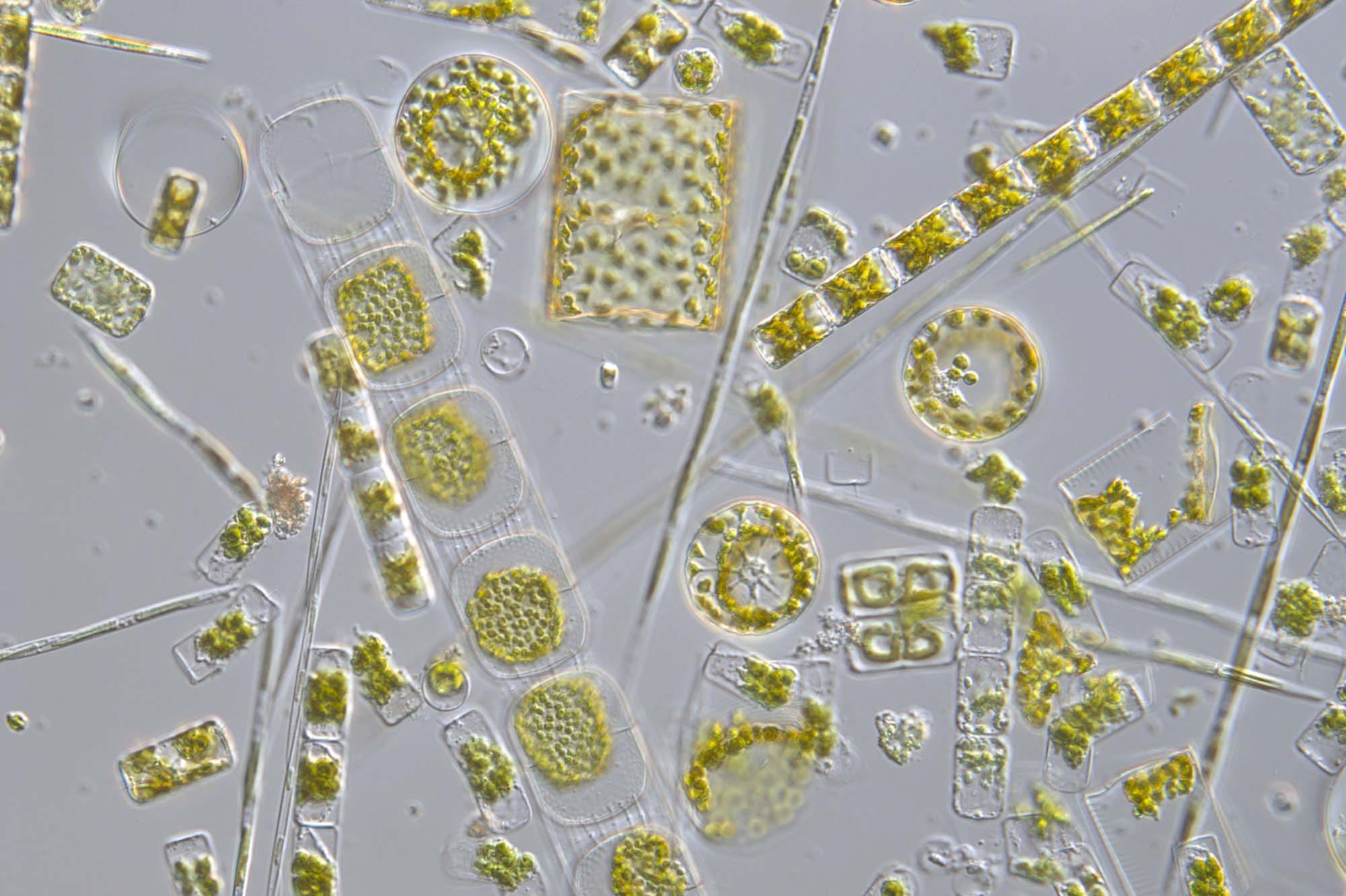
Phytoplankton —microscopic plants in the ocean— daintily sidestep both of the cost drivers that make most carbon dioxide removal uneconomic. Capture relies on photosynthesis, which is solar powered and therefore literally free. And storage relies on particles sinking through the water column, which is just gravity, which last I checked, was also free.
With $0 to pay for capture and $0 to pay for storage, phytoplankton carbon solutions begin life with an insurmountable cost advantage over other capture methods. The actual costs end up being associated with the actual minerals you’d need to add nutrients to marine deserts, but because you’re mostly talking about modest quantities of cheap minerals like iron, those just don’t add up to very much: no more than $5 per ton, and potentially as little as a few pennies. That leaves the cost of deployment — the boats and crews and such — and the cost of scientific monitoring, reporting and verification of carbon transport. Where that ends up settling once you scale is really uncertain, but there’s no a priori reason why it can’t settle at $25 a ton, or potentially quite a bit less.
This is why I tend to think we should spend all our time developing Phytoplankton Carbon. It has a clear, credible path at delivering a sub-$25 ton of carbon dioxide removal that’s both ecologically sound and long-lasting. It can do this because it puts two big fat zeros in the Excel cell where most CDR methods have the bulk of their costs: capture energy and storage.
Maybe there’s some other technique that can match that. If there is, I haven’t heard of it.
Researchers are calling the past ten years,’The Golden Age of Microbiology’ because until about ten years ago it was difficult to discover much less study microbes that you couldn’t culture. Now it’s possible to detect and study even partial bits of DNA in samples with new software and hardware advances. Great candidates for Nitrogen fixing microbes will appear as will approaches for growing them at scale. The tropical deep blue oceans will be the canvas for this new vision. The most positive developments in the field. Thanks for your great work.
From my readings the process only allows for storage of very low quantities as most of the co2 is recirculated, I agree that redistribution of ocean nutrients is needed for healthy oceans and wrote a post on this. I have also been working on flat semi arid land spreader levee systems for the control of water across much of the flat, parched and carbon poor areas of the globe. Low, up to half meter high levees can stretch for many kms and retard irregular high flow events spreading water long enough to soak into these hydrophobic soils. I placed a couple of articles for comments . AI analysis states that carbon storage through rehydration could cost effectively stabilize our carbon budget and allow for tropical transfer of many agriculture methods including tire rubber and ethanol. I was surprised by the quantities involved and the cost should be minimal as it is incorporated in lower cost agricultural output. This method also lowers heat extremes and has beneficial down wind attributes for our whole agricultural system as well as flood and drought implications.
Please fell free to comment, I knew that our semi arid soils were some of the most carbon impoverished on the planet but even I was surprised by the AI analysis.