


It’s always useful when your ideological opponents drive their arguments over the edge of reason — it saves a lot of debunking.
Thomas Piketty’s done us all a service by really following through on the implications of his own ideas, boarding the reductio ad absurdum train and absolutely, positively refusing to get off until the final stop.
In the Global Justice Report — launched last week at his World Inequality Lab’s big Paris conference — Piketty argues that drastic action is needed to curb global emissions enough to keep the planet habitable. As the coordination problem is global in scale, the authority that leads the response will need to be global too: to wit, a Global Justice Fund with full fiscal powers and an aggressive agenda to massively redistribute global income.
He wants the Fund to absorb around 10% of world GDP a year (~$12 trillion, bigger than the German and Japanese economies combined), and cut annual working hours from ~2,100 to ~1,000 per worker.
He doesn’t call it a world government, but that’s a world government.
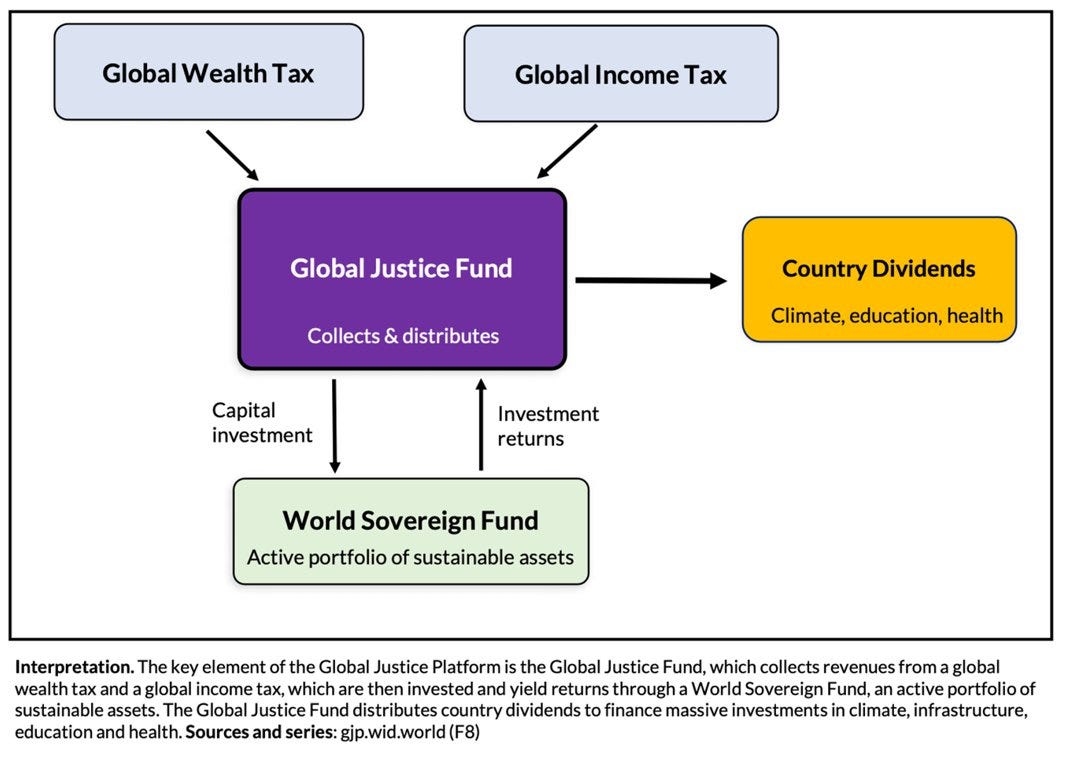
A big part of the point is supposed to be to keep the world habitable, which the report equates with with a call for very fast emissions reductions. This implies not just a global government, but one powerful and independent enough to impose a radical agenda to deliver them. This demands not just increasing the rate at which advanced economies are decarbonizing but also deep cuts in emissions from poor countries.
You can dress it up in all the progressive phraseology you want, but the reality is that this would mean deepening poverty for billions of people in the developing world. Given a choice, voters in the developing world will never vote for this: it will have to be imposed on them.
Look, Piketty’s analysis is not wrong, exactly; just crazy. He’s right that if you want to regulate a negative externality at the global level, you’re going to need some kind of global sovereign authority to achieve that.
It’s precisely the fact that there isn’t any such thing as a global authority that makes responding to climate change hard. The limp mechanism we have for coordinating action between Westphalian states — the UN — definitely is not a global sovereign, which is why its attempt to fit the round peg of restricting greenhouse gas emissions into the square hole of voluntary coordination between formally equal and sovereign states hasn’t worked, doesn’t work and won’t work.
If your one policy response to climate change is drastic emissions reductions, then you can’t do it without a world government. It’s just that a sane person looks at that sentence, realizes “oh, but there isn’t the slightest sliver of a chance we’re going to get a world government anytime soon,” and draws the obvious conclusion: we’re never going to get drastic emissions reductions, period.
This is one of those very obvious things people resist saying because we’ve been taught it’s the end of the world. That it’s plainly true, that all the data show it’s true, that economic theory and political common sense support it, that the yearly farce that is COP illustrates it, that deep down we all know it’s true doesn’t make it more sayable. That’s how taboos are: things we don’t say because they point at truths that are too unpalatable. Markers of chosen ignorance.
Thomas Piketty has just put himself through the ordeal of writing a whole fancy report to pretend that this very obviously true thing isn’t true, and that a world government is a live possibility, and that it should be led by people who think just like him for the purpose of delivering on his agenda.
The report calls for the Global Justice Fund to be “governed by strict rules of democracy and transparency”, but then also wants it to prioritize degrowth. What happens when the world’s voters refuse to vote for GJF leaders who promise to make them poorer is one of the many, many obvious objections the report artlessly elides.
Look, to deliver on the goals set out for it, the GJF would have to act as a kind of global dictatorship: imposing policies that voters would never back, policies favored exclusively, as far as I can tell, by a minuscule elite of first-world degrowther intellectuals who hang out with Thomas Piketty — so maybe not the most promising basis for stable world government.
The entire thing is harebrained and stupid in the kind of way only someone locked inside a hermetically sealed echo chamber could fail to notice. It’s just ridiculous.
But I’m indebted to Piketty for following the degrowth agenda through to its utmost consequences — and just sort of mystified he doesn’t seem to realize he’s debunking his own agenda a lot more convincingly than I ever could.
Because, again, Piketty is not wrong; just crazy. He’s right that without a world government, emissions are going to peak sometime in the next ten years, then fall too slowly to meet our Paris Agreement targets.
The smart response to that isn’t despair, it’s realizing that emissions are the wrong policy target. We can get at the problem in other ways — ways that don’t require cheerleading for a global envirodictatorship.
Developing pathways for carbon dioxide removal at scale won’t scratch Thomas Piketty’s Central Planning itch, of course. It won’t gel with his watermelon politics — all green on the outside, red inside. What it will do is solve the problem. Which, y’know, oughta count for something.
I believe that many people who lean left politically need to do a hard reality-check on what they really believe about totalitarism. I don't say that because I believe that they are bad people, but many have eluded themselves to believe that they, deep down, believe in freedom, compassion and are in opposition to ideologies like Fascism, but when push comes to shove, like questions on how to solve rising inequality or climate change, it often quickly becomes clear that they secretly yearn for the iron fist of the state to enact this. Covid was a revealing moment in my opinion, where many people who professed liberal attitudes came out in favor of strict state-sponsored sanctions on the personal liberties of citizens, sometimes in a scaringly insistent manner.
The problem is that carbon capture is exactly as impossible, and you are articulating it as the reasonable solution.
We as a species are dead-set on destruction. After a few years of flattening of energy use, and the near-elimination of coal, we decide to blow out AI, and now we will consume more energy and revitalize coal.
Piketty isn’t insane, we are.