

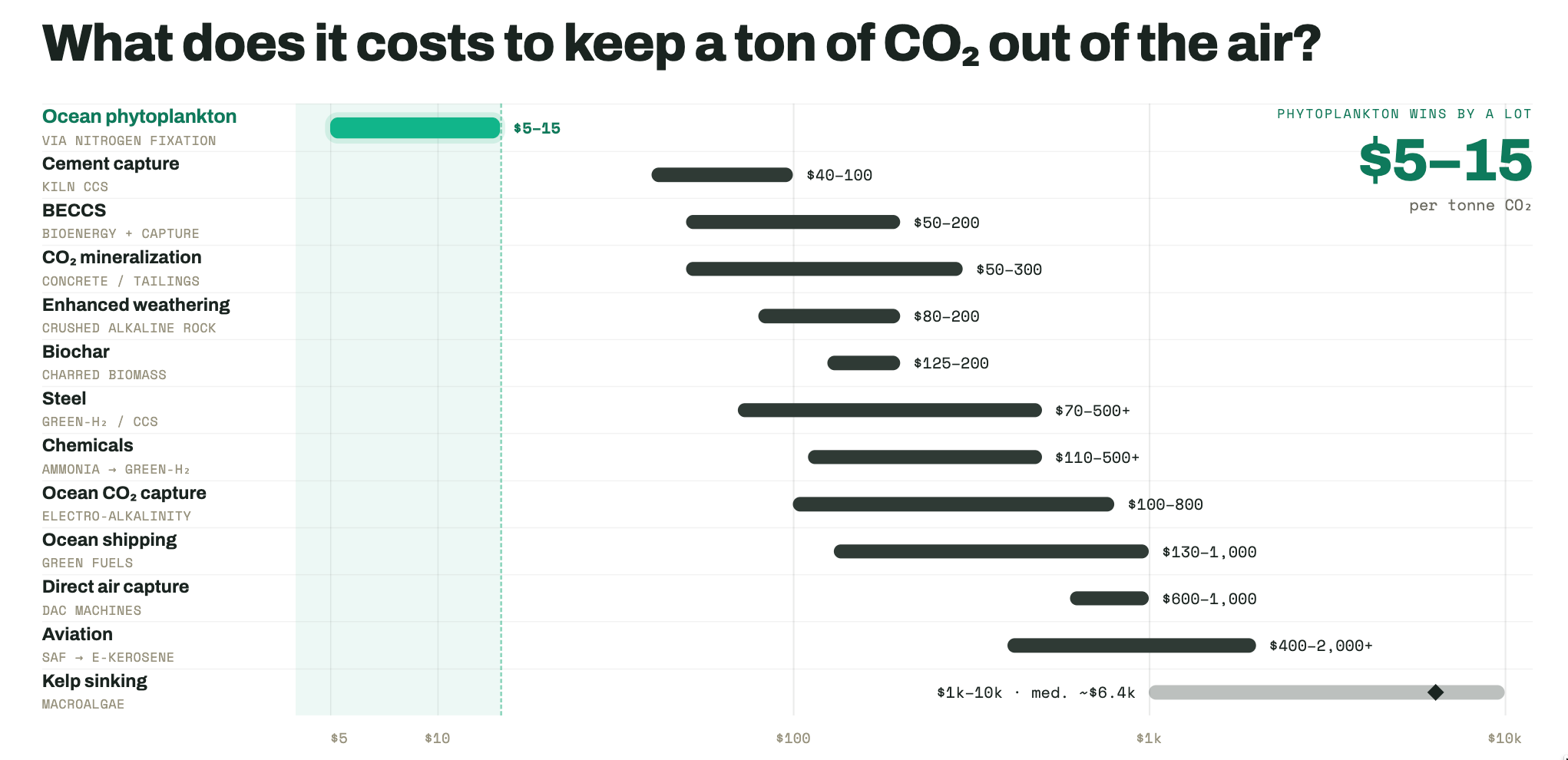
Durably pulling a ton of carbon dioxide back out of the atmosphere has the same climate impact as never having emitted it in the first place. The sky doesn’t keep track of why a ton isn’t there. For climate policy, a ton of CO₂ you’ve durably removed is the same thing as a ton of CO₂ that you avoided emitting in the first place.
This isn’t some fringe position. The IPCC’s Sixth Assessment Report — the most heavily scrutinized document in all of climate science — says that “the deployment of carbon dioxide removal to counterbalance hard-to-abate residual emissions is unavoidable if net zero CO₂ or GHG emissions are to be achieved.” The discourse treats carbon dioxide removals as somehow different from reducing emissions; the science doesn’t do that.
So if a removed ton equals an avoided ton, and if the money the world will actually spend on climate is finite, the whole problem boils down to one question: how can we do this cheapest? If we think about it logically, spending $100 to lower carbon emissions from shipping by one ton, say, only makes sense if capturing carbon dioxide costs more than $100 per ton. If we had a $50 ton of removals, then insisting on spending that $100 on abating shipping emissions would have the net effect of leaving one more ton of CO2 in the atmosphere than needed.
Climate discourse ought to center how much keeping carbon out of the air actually costs. A method’s cost is set by physics, and every approach has a cost floor, because you can’t negotiate with the laws of thermodynamics. The cheap pathways piggyback on free shit: sunlight, photosynthesis, gravity. The expensive ones need lots of expensive power, or land, or machinery, or all of the above.
So where are those cost floors? And why?
Direct air capture — giant air-filtering machines get the job done for $600–$1,000 a ton. The problem is dilution. CO₂ is 0.04% of the air, so to collect one ton you have to comb through the carbon scattered across roughly 1.3 million cubic meters of atmosphere — a cube of air about 110 meters on a side, taller than a 30-story building — and then heat a sorbent to shake the CO₂ back off. The theoretical thermodynamic floor is about 240 kWh a ton, but real machines burn ten times that or more, because they have to run fans and supply heat. Here the energy bill is the floor, and it’s why the aspirational target is still $400–$600, not $40.
Cement and chemicals — about $60–$100 a ton for cement, ~$110 and up for chemicals. The mechanism is not so different than in DAC, but here the CO₂ comes concentrated from an industrial process. Around 60% of cement’s emissions aren’t from fuel at all; they’re chemistry, CO₂ driven straight out of the limestone as it’s cooked, and no amount of clean energy touches that. But the gas leaves the kiln as a thick stream, 20–30% CO₂ instead of 0.04%, so scrubbing it out costs roughly ten times less than pulling it from open air. Ammonia plants are cheaper still, because they already vent a nearly pure CO₂ stream you can simply catch.
Green steel — roughly $200 a ton, north of $500 where power is expensive. Making steel without coal means making it with hydrogen, and making hydrogen means electricity — about 2.6 MWh per ton of steel, plus another to run the furnace, call it 3.5 MWh a ton. Put that against the world’s ~1.9 billion tons of steel a year and you need more electricity than the entire United States generates — about half again as much — built from scratch and all of it clean. Green steel isn’t really a metallurgy problem, it’s an energy problem.
Ocean electrochemistry — $100 to $800 a ton. Run a current through seawater and you can split it into an acid and a base; dose the base back into the sea and it drinks up CO₂ like a planet-sized antacid. It works. Companies like Equatic are selling it around $500 and chasing under $100 by 2030. But the current is the catch: even on optimistic numbers it takes on the order of 1.4 MWh per ton, so a gigaton-a-year industry would swallow roughly a third of all US electricity. Again, cheap, clean power is the whole ball game.
Ocean shipping — $130 to $1,000 a ton. Green ammonia and methanol are really just hydrogen wearing a more shippable coat, so they inherit the electricity bill; the top of the range ($700–$1,000) is the genuinely clean stuff. Ships need dense, storable energy, and clean dense energy costs more to make.
Aviation’s e-kerosene — $2,000+ a ton, the most expensive thing here. This is where the costs pile on top of one another. To make synthetic jet fuel you need carbon (captured from the air — so you inherit direct air capture’s whole bill) and hydrogen (electricity, again), and then you spend still more energy welding them into a fuel molecule, shedding most of it as waste heat at every step. Feed in 100 units of clean electricity and about 40 come out the far end as fuel. You’re running DAC and then paying a second and third time to turn its output back into something you can burn. It works, if you can call something that’s an order of magnitude more expensive than everything else “working.”
Enhanced weathering — $80–$200 a ton. Certain rocks pull CO₂ from the air as they weather; crush them fine and spread them on fields or beaches and you speed up a key natural process. The floor here isn’t energy, it’s sheer tonnage. You need something like 1.2 tons of rock per ton of CO₂, so a gigaton-scale industry means mining, grinding, hauling and scattering about 1.2 billion tons of rock every year. Picture the biggest mining trucks on Earth, the 360-ton haulers, each loaded with its share: bumper to bumper that line would run about 50,000 km — long enough to circle the equator and keep going a quarter of the way round again. Moving stuff at that scale is never cheap.
BECCS — $50–$200 a ton. Grow plants, burn them for power, capture the CO₂, bury it. The plants do the capture for free, on sunlight — but sunlight is diffuse and photosynthesis banks only about 1% of it, so the binding constraint is land. Pulling down a gigaton a year this way would take roughly 30 million hectares planted in nothing but fuel — about the area of Italy, replanted every year. Scale it to the levels the climate models lean on and you’re eyeing a serious slice of the world’s cropland. Land is the floor, so now carbon dioxide removal is in direct competition with food production and wildlife.
Biochar — $125–$200 a ton. Char biomass instead of letting it rot and the carbon stays locked up for centuries, while the pyrolysis throws off usable heat as a bonus. It’s the cheapest engineered removal going, which is why it’s roughly 90% of the durable removal actually delivered so far. Its floor is the feedstock. That can be cheap if you’re burning waste — sawmill offcuts, crop residue, nutshells. Run out of waste and you’re back to growing biomass on purpose, at which point biochar inherits BECCS’s land problem.
Kelp — thousands of dollars a ton, median around $6,400. Growing seaweed and sinking it sounds like it ought to be nearly free; the ocean grows the kelp. But everything around the kelp is costly: seeded twine, moorings, vessels, labor, storms, and the befuddling, awkward problem of proving the carbon actually stayed down. You’re running an offshore farm to raise a crop whose only value is its carbon, then financing a complicated science project to verify it worked. Ocean operations set the floor, and the open ocean is an expensive place to work.
Trees — $5–$50 a ton, but they don’t really count. What kind of monster could be against planting a tree!? Photosynthesis is free, which is why it’s the lowest number on this list. If you tried to scale it, you’d run into the same land availability limits as BECCS and biochar, but that’s not the real problem. The real problem is permanence — fire, drought, rot, or a chainsaw can hand the carbon back within a few decades. This is a list of durable removals, trees don’t count.
Phytoplankton — $5–$15 a ton. This is the one I work on, and it’s cheap for the same reason trees are cheap: photosynthesis. In the sunlit ocean, microscopic ocean plants already fix staggering amounts of carbon for free; across huge stretches of sea the only thing capping that growth is missing nutrients. Where only iron is missing, a single atom of iron can lead to the removal of 23,000 molecules of CO₂. We’re talking pennies’ worth of material per ton of CO2 removed. Where phosphates or other stuff are in short supply, material costs are higher but still very manageable, maybe $5 per ton. Sunlight provides the energy, and gravity the permanent removal. You’ll never run out of room to do this in — up to half the surface of the planet is covered in marine deserts where these approaches could work. Deployment would cost something, though since you’re mostly adding mineral nutrients to the surface you could easily do this with unmaned surface vehicles. What really drives costs is measurement — proving how much carbon sank and proving that it stayed sunk.
Phytoplankton carbon removal isn’t proven yet — we’re working on it! But if we thought about this problem logically, we would focus the bulk of our research energy here because it has a much, much lower cost floor than other proposed approaches.
The real payoff comes from the mindset shift. Come at CDR with an engineering mindset and you end up trying to capture carbon by out-muscling physics with giant machines. Phytoplankton isn’t like that. It’s a nature-based solution: you’re not inventing a new carbon dioxide removal mechanism, you’re piggybacking on the oldest of all the carbon dioxide removal mechanisms, the one evolution came up with billions of years ago.
That’s the bet. And yes, I am fundraising: if you have a couple of spare million dollars lying around and want to help make it happen, you know where to find me.
This is one of the most relevant things I have read recently
This is very very useful. Quico is the first writer I have found on Substack exercising and extending carbon economics. I love the supply curve.
In my Restack I use our shared carbon economics to argue that biochar is better than it looks, and describe a prototypical Washoe Forests Carbon Bank.
We turn crappy local currency into TAC values. Because we hold verifiable physical assets (including co-produced locally dispersed biochar) we create, attract, and invest financial TAC assets as well.
The carbon-capture supply curve is obviously of core interest to carbon bankers.
I love your work. Thank you.