

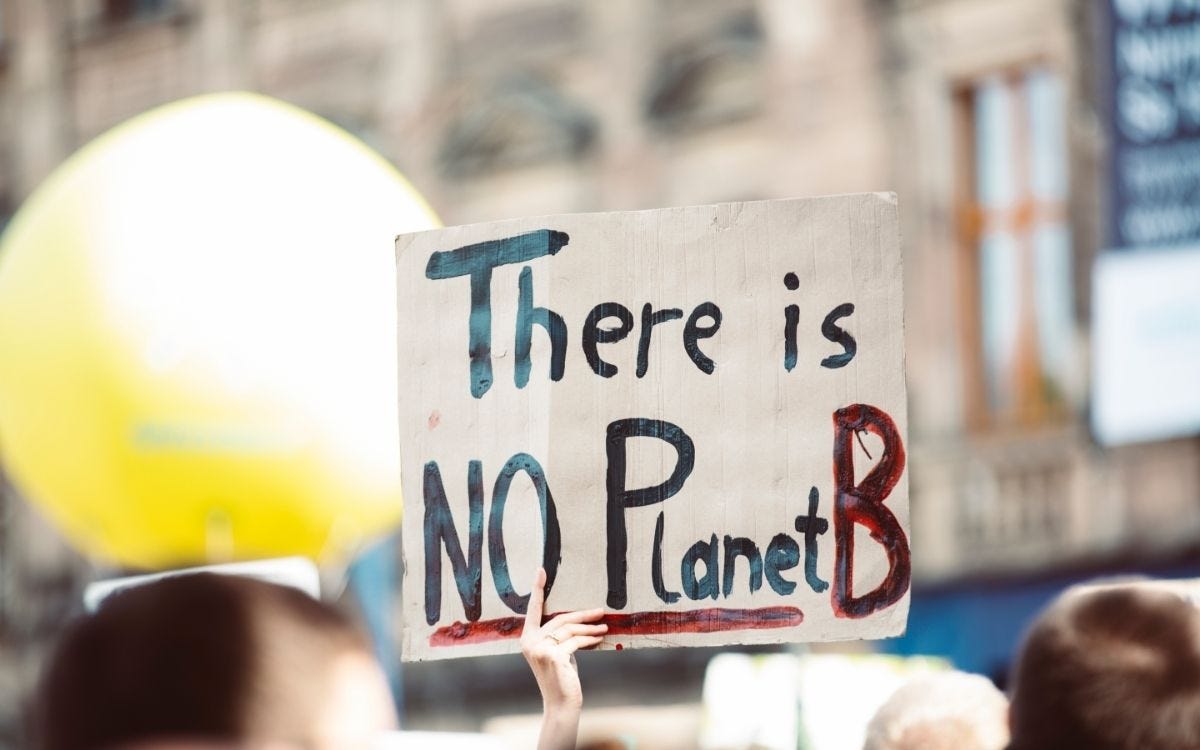
Is there a future for climate activism once we accept what we’ve been doing hasn’t been working? Of course there is! It’s going to imply a hard pivot for a movement not much given to pivoting, granted. It’s going to take unlearning a bunch of old instincts and learning a bunch of new ones. It’s going to imply being for new things and not just against old ones. It’s going to mean looking at climate all over again, from first principles, and focusing our efforts on stuff we’ve not thought it our job to think about.
Here’s the thing, though: it could work. It could stop climate change. It might even begin to reverse it.
Imagine that!
For pretty much its entire existence, the climate movement has been about one thing: curbing the emission of greenhouse gases. Ever since the original Rio Earth Summit in 1992, when CO2 concentrations were at 356 parts per million, fighting emissions from burning fossil fuel has been what the movement is about and for.
The theory of change was simple: if we got enough people to change their behavior enough, we’d emit less and stop the earth from warming so fast.
Here we are 34 years later, and CO2 concentrations are at 427 ppm, and still rising.
It didn’t work. We fought fossil fuel companies, hard. We taught generations of schoolchildren about the stakes, and urged them to change their habits to emit less.
It seemed promising, but it didn’t work. When you have a strategy that doesn’t work, doing it harder is…not a sensible way forward.
Collectively, we’re starting to accept that. The UN has, in its own way, come to terms with it. The recent UN Environment Programme report on overshoot will be remembered mostly for finally accepting, in so many words, that limiting emissions won’t deliver a stable climate.
Which, in itself, is huge.
I have my own views about why mitigation didn’t work, but in a way the why doesn’t much matter. Just accepting the plain fact that mitigation is not enough counts a major step forward. If you want to have a serious conversation about the climate, this is table stakes.
If mitigation doesn’t work, what might? Logically, only two things: we can try to reduce the amount of heat that reaches the planet in the first place —solar geoengineering— or we can reduce greenhouse gas concentrations directly — by removing carbon dioxide from the atmosphere billions of tons at a time.
But really, it’s not an either/or. Even if you’re convinced we need solar geoengineering, you’ll soon come to realize it’s not enough on its own. Masking global warming can’t be a stable solution to the problem, for reasons that become obvious when you think about it carefully. Increasing albedo does nothing to stabilize the chemistry of the ocean, which is quickly acidifying. And it creates potentially catastrophic “termination shock” scenarios where, for some reason, the program gets interrupted and temperatures rise very quickly as a result.
Which leaves gigaton-scale carbon dioxide removal as the thing everybody who’s thoughtful about the climate can now agree on. It’s telling that the scientists are leading the way. The new CMIP7 scenarios and the recent UNEP overshoot report show a consensus consolidating around this idea at the IPCC.
Of course achieving gigaton-scale CDR will be a huge planetary challenge, one that will define our relationship with the climate for the rest of this century. There is no path to the Paris Agreement goals that doesn’t involve removing carbon dioxide we’ve already emitted, gigatons at a time.
Of course, it’s going to take some time for climate activists’ muscle memory to catch up with this new reality. We’ve spent so long thinking of 'climate activism’ as a synonym for ‘fighting fossil fuels’ that we can’t expect a new identity to develop all at once.
For four decades now, climate activists have been happy to treat carbon dioxide removal as a kind of sideshow for some of the nerdier, more engineering-minded members of the community. It’s been perfectly acceptable to build your entire activist identity around fighting fossil fuel companies and advocating renewable energy —the core of the mitigation agenda— without ever really engaging with the CDR world.
This position is not really defensible anymore. Because we know —IPCC scientists are telling us plainly— that there is no stable climate future without gigaton scale CDR.
If you’re a climate activist, you can’t really ignore this stuff anymore. Not in good faith.
And you know what, this is good! Because it gives us something to be for! It’ll transform us from a movement that’s against something —fossil fuels— into a movement that’s for something: developing safe, affordable, gigaton-scale Carbon Dioxide Removal.
It’s a huge undertaking, and absolutely necessary. Right now, we definitely don’t have CDR technologies that have any realistic chance of reaching gigaton-scale. We need to develop those technologies, which means that the most useful thing a climate activist can do in 2026 is advocate loudly and consistently for the development of these technologies.
How much is your country spending on research and development for gigaton-scale CDR? What is your company doing to support research to develop gigaton-scale CDR? How much of your philanthropy is pointed in this direction?
If the answer is “not much,” that answer is going to have to change.
Because my calendar says it’s 2026, and by this stage a mitigation-only approach is becoming its own form of denialism, just as divorced from the scientific consensus as the older kind of denialism.
We know what we need to do. Time’s a’wastin’.
Deep down most climate activists don’t believe that climate change is an existential threat. If they did, they would have been all in for nuclear.
Hope to hear more details. Can I buy a brush-pile incinerator with a carbon-capture flue? Plant deep-rooted native bunch grasses? Contribute to a cutting-edge science lab?